

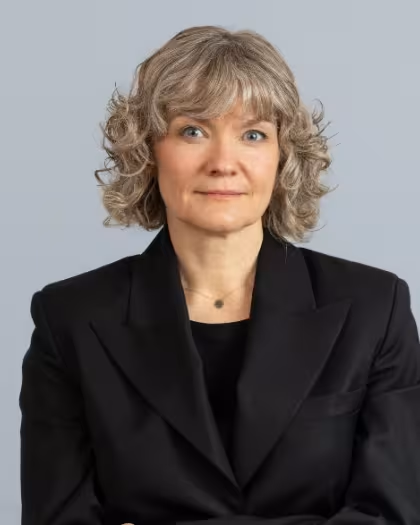
Ragnhild Louise Muriaas
Position
Professor, Political science
Affiliation
- ragnhild.muriaas@uib.no
- Phone number
- +47 96514015
- +47 55589448
- Visitor address
-
Christies gate 17
5007 Bergen - Room: 315
- Postal address
-
P.O. Box 7802NO-5020 BergenNorway
Follow me
Ragnhild Louise Muriaas
Position
Professor, Political science
Affiliation
Research groups
Short info
Research
Ragnhild Louise Muriaas is currently the project leader of a ERC project (consolidator) titled (2021-2026). The project builds a dataset on gender gaps in political seniority and conducts fieldstudies in Algeria, Italy, France, and Norway.
The article (2024) published in Politics and Gender demonstrates the large size of gender gaps in political seniority across 9 established democracies (1965-2021). The article is featured in ECPR's The Loop with the title .
Ragnhild Muriaas is also involved in an international research project on led by Vibeke Wang at the Chr. Michelsen Institute. This project aims to better understand how gender shapes the scope, form, and consequences of political violence targeted at politicians, and to develop strategies to reduce the problem.
Since Autumn 2023 Ragnhild Muriaas has served as scientific coordinator of the Norwegian Panel of Politicians.
From August 2022 to July 2023 she was a visiting scholar at Science Po (Paris) at LIEPP (Fall) and Centre for European Studies and Comparative Politics, CEE (Spring).
Her work has appeared in such journals as the , Comparative Political Studies, African Affairs, Political Studies and International Political Science Review. Professor Muriaas is the editor of Gendered Electoral Financing: Money, Power and Representation in Comparative Perspective (2020) - with Vibeke Wang and Rainbow Murray and she has written the book Manipulating Political Decentralization: Africa's Inclusive Autocrats (2018) with Lovise Aalen.
From 2017 to 2021 she was research dean at the Faculty of Social Sciences and from 2018 to 2022 she was the leader of the board at the Centre for Women's and Gender Research (SKOK) at the University of Bergen.
Outreach
Washington Post - Monkey Cage: with Amy Mazur and Season Hoard
Democracy in Africa: med Vibeke Wang og Gretchen Bauer
UCL The Constitution Unit: with Rainbow Murray and Vibeke Wang
Washington Post - Monkey Cage: with Lindsay Benstead, Vibeke Wang, Boniface Dulani and Lise Rakner
The Money Talks: Women and Elections in Malawi film, can be , and you can read an interview about the making of the short film .
Teaching
Current teaching:
GOV217: Gender and Power in Contemporary Politics
GOV114: Politisk teori og syteformer (Political Theory and Regime Types)
Examples of previous courses:
AORG104 Politisk teori og styreformer (Political Theory and Regime Types)
SAMPOL221 The Politics of Gender in a Global Perspective
EUR 101 Introduction to European history and politics
SAMPOL 327 The Politics of Gender: Citizenship, Representation and Development
SAMPOL 100 Introduction to Comparative Politics
SAMPOL321 Political Parties in Post-Conflict States
Publications
Torill Stavenes and Ragnhild Muriaas (2026). Seniority amidst Change: Parliamentary Turnover and Legislative Persistence in 14 European Democracies. Government & Opposition. Accepted.
Muriaas, Ragnhild and Torill Stavenes (2026).. Political Behaviour. Online first.
Muriaas, Ragnhild, Mads Thau, Marte Winsvold and Vibeke Wang (2026). . Representation. (online first)
Francesca Feo and Ragnhild Muriaas (2026) Women's pathways to power. Chapter 86. In Zoe Lefkofridi (ed). . Edward Elgar Publishing.
Ragnhild Muriaas, Marianne T酶raasen (2026). , Social Politics: International Studies in Gender, State & Society 33(1): 147-172.
Winsvold, Marte; Thau, Mads; Muriaas, Ragnhild Louise & Wang, Vibeke (2025). I Saglie, Jo; Segaard, Signe Bock & Christensen, Dag Arne (Red.), Lokalvalgene 2023: maktforskyvning og normalisering. Cappelen Damm Akademisk, p. 321鈥�349.
Ragnhild Muriaas and Yvette Peters (2025). . European Journal of Political Research, 64(1): 181-206.
Jana Belschner and Ragnhild Muriaas (2025). . Fagbokforlaget
Ragnhild Muriaas and Torill Stavenes (2024). . Politics and Gender, 20(2): 271-295.
Ida-Elise Seppola Asplund, Johanne Sofie Malde og Ragnhild Louise Muriaas (2024). , Norsk statsvitenskapelig tidsskrift 40(2): 117-124.
Lindsay Benstead, Ragnhild Muriaas and Vibeke Wang (2023). Social Politics 30(2): 496-524.
Rainbow Murray, Ragnhild Muriaas and Vibeke Wang (2023). . International Political Science Review 44(1): 3-12.
Vibeke Wang, Ragnhild Muriaas and Gretchen Bauer (2023). . International Political Science Review 44(1): 77-90.
Ragnhild Muriaas, Amy Mazur and Season Hoard (2022). . American Political Science Review, 116 (2): 502-515.
Lovise Aalen, Aslak Orre, and Ragnhild Muriaas (2022). In John Ishiyama and Gyda Sindre (eds.) The Effects of Rebel Parties on Governance, Democracy and Stability after Civil WarsFrom Guns to Governing. London: Routledge, pp. 157-174.
Martha C. Johnson, Ragnhild Muriaas, Amanda Clayton, and Amanda Lea Robinson (2021). Deeper Decentralization, Fewer Women? Decentralization and Women's Candidacies for Local Office in Benin and Malawi. In Leonardo Arriola, Martha Johnson, and Melanie Phillips (eds) . Ch. 4. p. 85-113. Oxford: Oxford University Press.
Chiweza, Asiyati Lorraine, Happy Kayuni, and Ragnhild Louise Muriaas (2021) . African Affairs, 120(481): 569-589.
Vibeke Wang, Ragnhild L. Muriaas and Yvette Peters (2021). . Journal of Modern African Studies, 59(4): 507-533.
Amanda L. Robinson, Amanda Clayton, Martha Johnsen and Ragnhild L. Muriaas (2020). . Comparative Political Studies, 53(3-4): 601-630.
Ragnhild Muriaas (2020) Gendered Electoral Financing: Two Approaches Toward Funding as an Affirmative Action Measure. In Jamil, I., Aminuzzaman, S.M., Lasna Kabir, S., Haque, M.M. (Eds.) Gender Mainstreaming in Politics, Administration and Development in South Asia, Palgrave.
Muriaas, Ragnhild, Vibeke Wang and Rainbow Murray (2019). Introduction: Introducing the Concept of Gendered Electoral Financing, pp. 1-24. In Muriaas, Wang and Murray (eds.) Gendered Electoral Financing: Money, Power and Representation in Comparative Politics. New York: Routledge.
Borges, Aleida, Ragnhild Muriaas and Vibeke Wang (2019). Cabo Verde: Legislated Candidates Quotas with Reward for Compliance in Cabo Verde: Victory for no one? pp. 74-92. In Muriaas, Wang and Murray (eds.) Gendered Electoral Financing: Money, Power and Representation in Comparative Politics. New York: Routledge.
Muriaas, Ragnhild and Amy G. Mazur (2019). Conclusion: Does Money Talk? An initial Comparative Analysis, pp. 154-174. In Muriaas, Wang and Murray (eds) Gendered Electoral Financing: Money, Power and Representation in Comparative Politics. New York: Routledge.
Ragnhild L. Muriaas, Vibeke Wang and Rainbow Murray (eds) (2019). . Routledge.
Vibeke Wang and Ragnhild L. Muriaas (2019). . Politics, Groups, and Identitites, 7(2): 401-411.
Muriaas, Ragnhild L., Vibeke Wang, Lindsay Benstead, Boniface Dulani and Lise Rakner (2019). '' Comparative Political Studies, 52(12): 1881-1924.
Cappelen, Cornelius and Ragnhild L. Muriaas (2018). . Scandinavian Political Studies, 41 (2): 167-187.
Lovise Aalen and Ragnhild Muriaas (2018). . Routledge.
Muriaas, Ragnhild L., Liv T酶nnessen and Vibeke Wang (2018). Political Studies, 66 (4): 851鈥�868.
Aalen, Lovise and Ragnhild L. Muriaas (2017) , International Political Science Review, 38 (1), 56-69.
Muriaas, Ragnhild, Lise Rakner and Ingvild Aagedal Skage (2016) , Civil Wars, 18 (2): 175-191.
Hilde Danielsen, Kari Jegerstedt, Ragnhild L. Muriaas and Brita Ytre-Arne (eds) (2016). , Palgrave Macmillian.
Hilde Danielsen, Kari Jegerstedt, Ragnhild L. Muriaas and Brita Ytre-Arne (2016). 鈥業ntroduction鈥�. In Hilde Danielsen et al. (eds) Gendered Citizenship and the Politics of Representation, Palgrave Macmillian.
Ragnhild L. Muriaas, Liv T酶nnesen and Vibeke Wang (2016). Substantive Representation: From Timing to Framing of Family Law Reform in Morocco, South Africa and Uganda. In Hilde Danielsen et al. (eds) Gendered Citizenship and the Politics of Representation, Palgrave Macmillian.
Muriaas, Ragnhild L. 2015. 'The Quality and Stability of Subnational Elections in Africa: A Methodological and Conceptual Tool', ch. 5. In Anthony Spanakos and Francisco Panizza (eds.) Conceptualizing Comparative Politics, New York, NY: Routledge.
Muriaas, Ragnhild L. and Lars Svaasand (2015) . Commonwealth and Comparative Politics, 53 (4).
Kayuni, Happy and Ragnhild L. Muriaas. 2014. 鈥�, Representation, 50 (3): 393-404.
Muriaas, Ragnhild L, Liv T酶nnessen and Vibeke Wang. 2013. '', Women Studies International Forum, 41: 89-93.
Muriaas, Ragnhild and Happy Kayuni. 2013. '', Women's Studies International Forum, 41: 150-9.
Muriaas, Ragnhild L. 2013. 'Party Affiliation in New Democracies: Local reactions to the split of the ruling party in Malawi', African Journal of Political Science and International Relations, 7 (4): 190-9.
Hussein, Mustafa K. and Ragnhild L. Muriaas. 2013. 'Traditional Authorities' in Nandini Patel and Lars Sv氓sand (eds) Government and Politics in Malawi, second edition. Lilongwe, Malawi: Capital Printing Press.
Muriaas, Ragnhild L. 2013. 'The ANC and power concentration in South Africa: does local democracy allow for power-sharing?' pp. 12-31. In Emil Uddhammer, Elliott Green and Johanna S枚derstr枚m (eds.) Political Opposition and Democracy in Sub-Saharan Africa, New York, NY: Routledge. (reprint).
Muriaas, Ragnhild L. and Vibeke Wang. 2012. , Journal of Modern African Studies, 50 (2): 309-38.
Mpesi, Andrew M, and Ragnhild L. Muriaas. 2012. '', Journal of Contemporary African Studies, 30 (3): 377-93.
Muriaas, Ragnhild L. 2011. 鈥樷�� Special Issue on Opposition in Africa, Democratization, 18 (5), 1067-86.
Muriaas, Ragnhild L. 2011. 鈥楾raditional institutions and dencentralization: A typology of co-existence in Sub-Saharan Africa鈥�, Forum for Development Studies, March, 38 (1), 87-107.
Muriaas, Ragnhild L. 2011. [African Challenges: An Introduction to African Politics]. 贬酶测蝉办辞濒别蹿辞谤濒补驳别迟.
Muriaas, Ragnhild L. 2009. 鈥�, Commonwealth & Comparative Politics, 47 (1), 28-51.
Muriaas, Ragnhild L. 2009. 鈥樷�� Government and Opposition, 44 (1), 91-112.
Muriaas, Ragnhild L. 2009. 鈥楢NC og maktkonsentrasjon i S酶r-Afrika: 脜pner lokaldemokratiet for maktdeling?鈥�, Politica, 41 (3), 283-99.
Book Reviews
Ragnhild L. Muriaas (2019). European Political Science, online first.
Ragnhild L. Muriaas (2013). 'Sexuality and Gender Politics in Mozambique: Rethinking Gender in Africa' by Signe Arnfred, Tidsskrift for kj酶nnsforskning, January, 88-92.
Working Papers:
Lindsay J. Benstead, Ragnhild L. Muriaas, and Vibeke Wang (2018). 'i'. Working Paper, No.16, The program on Governance and Local Development (GLD). Yale and University of Gothenburg.
Ragnhild Muriaas, Vibeke Wang, LIndsay J. Benstead, Boniface Dulani and Lise Rakner (2017). '', Working Paper, No.11, The program on Governance and Local Development (GLD). Yale and University of Gothenburg.
Reports:
The Local Governance Performance Index (LGPI) in Malawi: Selected FIndings on Gender (2017). Report prepared by Lindsay Benstead, Boniface Dulani, Ragnhild L. MUriaas, Lise Rakner and Vibeke Wang. GLD report. The program on Governance and Local Development (GLD). Yale and University of Gothenburg.
Dissertations:
Muriaas, Ragnhild L. 2008. Affection and Defection: Local Perspectives on the Pull Towards the Government Party in Malawi, South Africa and Uganda, PhD Dissertation, Department of Comparative Politics, University of Bergen.
Muriaas, Ragnhild L. 2002. Two Bulls in a Kraal - Recognising cultural difference in post-Apartheid South Africa, hovedfagsoppgave (M.Phil. Thesis), Department of Comparative Politics, University of Bergen.
Projects
Ragnhild L. Muriaas (Project leader). This is a five years ERC Consolidator Grant project (2021-2026).
SUCCESS will advance a novel theory of inclusion that explains gender-gaps in endurance and provide much-needed new empirical evidence on how, why and under what conditions gender-gaps in political endurance can be closed in a world with high electoral volatility.
- How does political endurance matter for political outcomes?
- What strategies do elected representatives use to sustain their political careers?
- How do voters evaluate political experience 鈥� when is it good and when is it bad?
- Are there specific institutions and contexts that underpin gender-gaps in political endurance across time, regions, and political systems?
PI Vibeke Wang, CMI. Research project financed by FRIHUMSAM, the Research Council of Norway (2020-2025).
Team: Gretchen Bauer, Elin Bjarneg氓rd, Jana Birke Belschner, Fiona Buckley, Akosua Darkwah, Gerald Karyeija, Stella Kyohairwe, Ragnhild Muriaas, P盲r Zetterberg
Across the globe, there has been a substantial increase in gender equality in political life. Women have more than doubled their presence in national parliaments from 1995 (11.3 %) to 2018 (23.4%) (Inter-Parliamentary Union). However, there are indications that women鈥檚 political gains may have come at a high cost. Practitioner organizations as well as academics seek to raise awareness about physical attacks, intimidation, and harassment aimed at women politicians. This project aims to better understand how gender shapes the scope, form, and consequences of political violence targeted at politicians, and to develop strategies to reduce the problem.
Project leader: Lovise Aalen, Research project financed by Norglobal, the Research Council of Norway (2019 - 2022)
Team: Asnake Kefale, Aslak Orre, Simbarashe Gukurume, Marjoke Oosterom, Gerald K. Karyeija, Ragnhild Louise Muriaas, Pauline Lemaire, and Salvador Forquilha
The population in sub-Saharan Africa is the fastest growing and the youngest in the world, yet the politicians ruling them are typically among the oldest.
This observation is the starting point of a new NORGLOBAL project. It zooms in on four countries 鈥� Ethiopia, Mozambique, Uganda and Zimbabwe 鈥� in which the current rulers are yesterday鈥檚 rebels. They consolidated authoritarian regimes after securing victory in the liberation struggles between the 1975 and 1992. The vast majority of citizens was born long after that, yet it knows no other powerholders.
While youth is an asset for any population, the above conundrum represents several challenges. One is 鈥渆conomic鈥�, as most of the sub-Saharan African economies struggle to produce enough decent work for the large youth cohorts that enter labour markets every year. The other is 鈥減olitical鈥�. Can the aging rulers govern in a way that satisfy the material needs and political aspirations of the upcoming generations?
Earlier projects:
.
Ragnhild L. Muriaas (Project leader). Research project financed by FRIHUMSAM, the Research Council of Norway (2016-2020).
Money is assumingly one of the greatest barriers to women in the political recruitment process. Particularly in candidate-centered electoral system where candidates compete twice: first in the primaries, and then, if they are successful, in elections at the state or national level. The financial disadvantage of women is expected to constitute an obstacle for women麓s entry into politics everywhere and especially in developing countries where women麓s socio-economic status is disproportionately low relative to men. This line of reasoning has caused a global upswing in financial schemes targeting women candidates, although the scholarship on women麓s representation has not followed suit. MoneyTalks represents a new research frontier by putting the effects of gendered electoral finaincing on the agenda. The project analyzes on how such schemes - separate from or in conjunction with gender quotas, interact with electoral processes and institutions that tend to be gendered across regions. Key cases are Cape Verde, Ireland, Kenya, Malawi, Tunisia and the United Kingdom.
Liv T酶nnessen (project leader). Research project financed by NORDGLOBAL, the Research Council of Norway (2013-2017). Ragnhild Louise Muriaas is principal investigator.
In the last decades the international community has placed women's political participation on the agenda. One of the key motivators behind this focus on women's political participation has been the assumption that there is a causal relationship between women's numerical representation on the one hand, and the substantive and symbolic representation of women on the other. This project focuses on questions related to women's representation in four African cases that have been key recipients of gendered aid the last decade (Malawi, Sudan, Uganda and Zambia). Muriaas main focus in this project has been studying reforms within the area of ending early marriages among key political agents in Zambia and Malawi, as well as, conducting survey experiments on the endorsement effects within reforms on early marriage, gender quotas and land reform in Malawi. The survey is conducted in collaboration with The Progamme of Governance and Local Development at Gothenburg (GLD), se
Labor migration and the moral sustainability of the Norwegian welfare state.
Stein Kuhnle (project leader). Research project funded by VAM, the Research Council of Norway (2013-2017).