

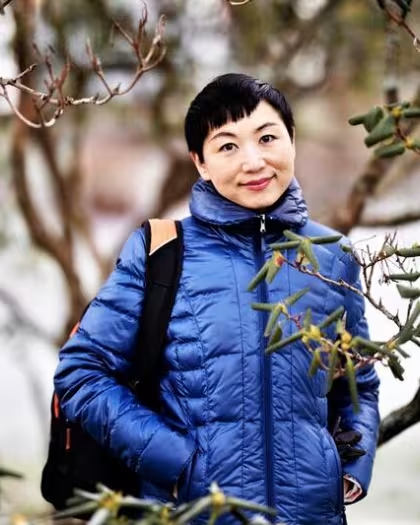
Huiwen (Helen) Zhang
Position
Professor, Chinese and comparative literature & philosophy
Affiliation
- huiwen.zhang@uib.no
- Phone number
- +47 55582327
- Visitor address
-
Sydnesplassen 7
5007 Bergen - Postal address
-
P.O. Box 7805NO-5020 BergenNorway
Follow me
Huiwen (Helen) Zhang
Position
Professor, Chinese and comparative literature & philosophy
Affiliation
Research groups
Short info
1-minute video: https://youtu.be/lefbQF28bAk
Research
I am Professor of Chinese and Comparative Literature & Philosophy at the University of Bergen. My research reconstructs how concepts travel across languages, disciplines, and historical moments — as well as how those journeys transform texts, methods, and the questions a field knows how to ask.
My trajectory now culminates in QuantACT,* a project that reconstructs how Niels Bohr, Werner Heisenberg, and Wolfgang Pauli engaged with ancient Chinese texts at moments when quantum physics had outgrown the conceptual language inherited from classical physics. The project is evidence-first and source-critical. It follows concrete mediation routes — translations, correspondence, philosophical horizons, and living interlocutors — through which these encounters became possible.
QuantACT counters loose parallels and superficial analogies by establishing what was actually read, through which channels, and with what documented consequences. Combining multilingual philology with archival research through transreading — a theoretical framework I have developed — the project distinguishes documented transmission, interpretive reconstruction, and clearly marked exploratory hypotheses throughout.
The current phase of QuantACT is shaped by reciprocal exchange with scientists. Recent conversations with physicists, biologists, informaticians, and machine learning researchers have moved the project from a mode in which the humanities explain themselves to science, toward one of mutual epistemic challenge that uncovers the possibilities and limits of each.
A central part of QuantACT is also visual. The maps, constellations, and galaxy diagrams I develop are not illustrations added after the fact. They are methods of reasoning: cognitive scaffolds in which sources, mediation routes, and degrees of certainty remain explicit, making entangled structures lucid and navigable. The visual and the conceptual are complementary. The digital development of these constellations is part of the research itself, and part of how QuantACT opens a shared interface between science and the humanities.
QuantACT is a live intellectual environment. I welcome conversation with researchers whose work touches physics, mathematics, biology, AI and LLMs, digital design, or the history and philosophy of knowledge — particularly where shared problems of causality, mediation, evidence, and the translation of concepts across disciplinary languages come into view. I pursue “interdisciplinarity” in the sense of curiosity-driven, evidence-based collaboration around problems that no single discipline can fully see on its own.
*QuantACT: Quantum Physicists in Contact with Ancient Chinese Texts
1-minute video intro to my 2026 publication in the Journal of Science and Literature:
Outreach
Hei! Jeg er transleser mellom kinesisk og germansk poesi og filosofi, som oppdaget en gullgruve i norsk og nordisk kultur etter å ha kommet fra USA til Norge i 2021. Det er først etter å ha reist rundt i verden og opplevd så mange forskjellige kulturer at du kan bli klar over både røttene dine og kallet ditt, og hvor du egentlig hører hjemme. Jeg har røtter i Kina, Tyskland og USA, men jeg hører hjemme i Norge.
Siste intervjuer:
Portrettintervju, «Huiwen (Helen) Zhang: Ekte kosmopolitt og hekta på Hauge», juni 2022:
Velkommen inn i slangens år: Studvest, February 2025.
https://www.studvest.no/kultur/velkommen-inn-i-slangens-ar/158741
Fem kjappe til Asia-eksperten: Huiwen Helen Zhang, Jan 2024, published online via Asianettverket:
Teaching
Created and taught over thirty courses in comparative literature, philosophy, religion, history, politics, cinema, popular culture, social media, creative writing, and journalism:
1. Modernity and Its Discontents: Scandinavia—Germany—Japan—China [Spring 2020, Spring 2019, Spring 2018, Spring 2017, Fall 2015, Fall 2014]
2. Transreading for Creative Writing [Fall 2020]
3. Tradition and Revolution [Fall 2020, Fall 2017]
4. Critical Thinking and Language Innovation [Spring 2020, Spring 2018]
5. Critique via Social Media [Spring 2020, Spring 2017]
6. Modern Europe Transreads China: Alternative Solutions for 20th-Century Issues [Fall 2019]
7. Contemplative Cinema [Fall 2019, Spring 2016]
8. Kafka and Daoist Philosophy [Summer 2019]
9. Poet—Warrior—Philosopher [Spring 2019]
10. Critique via Popular Music [Spring 2019]
11. Transreading across Genres [Fall 2018]
12. Anatomy of “Breaking News” [Fall 2018]
13. Voicing Sentiments [Spring 2018]
14. Transreading Literature as History [Fall 2017]
15. Philosophy in Literature [Spring 2017]
16. Transreading Prose Poetry [Spring 2016]
17. Cross-cultural Microblogging [Fall 2015, Spring 2015]
18. Modern Poetry and Prose [Fall 2015, Spring 2015, Fall 2014]
19. Untimely Meditations: A Chinese Perspective [Spring 2014]
20. Global Cinema: The Chinese Contribution [Spring 2014]
21. The Dilemma of Modernity: Kierkegaard to Kafka [Fall 2013]
22. Concealment and Revelation: Transreading Lu Xun [Spring 2013]
23. The Wanderer in Hong Kong Cinema [Fall 2012]
24. Modernization and Its Discontents: China—Germany—Scandinavia [Fall 2012]
25. Chinese Microblogging [Fall 2014, Fall 2013, Spring 2012]
26. Authentic Beauty: Chinese Perspectives (1979-present) [Spring 2012]
27. Modernization and Its Discontents: Lu Xun—Nietzsche—Georg Brandes [Fall 2011]
28. Act it out—Chinese through Theatre [Fall 2011]
29. Authentic Beauty: Chinese Perspectives (1917-1978) [Fall 2013, Fall 2012, Fall 2011]
30. The Treasure of Sorrow: China’s Lost Generation [Spring 2011]
31. Blessed in Translation [Spring 2011]
32. Four Faces of the Wanderer: An Exploration of Modern Chinese Literature [Fall 2010]
33. Nietzsche’s Superman and Daoist Philosophy [Spring 2009]
Publications
Siste publikasjoner:
“Transreading the Resonance between Science, Philosophy, and Poetry” (2026)
1-minute video abstract of my new publication:
“Cracking ‘A hard nut’: How Kafka and Hauge Transread Laozi”&²Բú²õ±è;
“A Perfect Bliss-Potential Realized: Transreading ‘Wish, to Become Indian’ in Light of Kafka’s Dao”&²Բú²õ±è;
“Transreading in the Nordic Mode: Olav H. Hauge in Dialogue with Laozi and Eckhart”&²Բú²õ±è;
“Richard Wilhelm and Alfred Döblin Transread the Chinese Tradition”&²Բú²õ±è;
Siste presentasjoner:
«Olav H. Hauges boksamling og nordisk translesing», Manuslokking: Boksamlingas forteljingar, Seminar i Aasentunet i Ørsta, October 17–18, 2024.
„Das deutsche Daodejing? Kafkas Geduldspiel mit Laozi“, University of Rostock, June 20, 2024.
«Kafkas Dao: ein Geduldspiel mit Laozi, Goethe und Nietzsche. Ein Transreading-Workshop mit Prof. Dr. Huiwen Zhang». Eine Zusammenarbeit zwischen DIMAS und dem Lehrstuhl für theologische Philosophie, University of Regensburg, May 24, 2024.
«Å se» Hauges gestalt med Laozi, Heraklit, Blake, Emerson, Whitehead og Kafka: Filosofi ved poesi, fra paradokser til aforismer (Bergen, april 2024)
Å knekke ‘en hard nøtt’: Kafkas og Hauges translesing av Laozi (Bergen, des 2023)
Reach for the Highest: Transreading Laozi and Eckhart through Olav H. Hauge (Aarhus, oct 2023)
Sidan har ingen spurt etter ferskenblomekjelda? Olav H. Hauge transleser T’ao Ch’ien (Haugesenteret Ulvik, sep 2023)
A German-Jewish Outsider: Alfred Döblin Transreads Laozi, Liezi & Confucius, European Association for Chinese Philosophy Conference “Interpretation and Reinvention” (Macerata, jun 2023)
Kafka’s Dao: The Patience Game, University of Chicago Center in Paris Symposium, “Translation and the Irreducible Plurality of Languages” (Paris, april 2023)
(Bergen, jan 2023)
(Bergen paneldebatt, mai 2022)
(Bergen paneldeatt, nov 2021)
Projects
Current International Team Project: QUANTACT
Quantum Physicists in Contact with Ancient Chinese Texts: Transreading the Resonance between Science, Philosophy, and Poetry
QUANTACT traces, for the first time, the dialogue of European quantum physicists with ancient Chinese texts, as well as with their global interlocutors in philosophy and poetry, who also engaged with these texts. Indeed, a unifying spirit that drew such diverse modern cultural figures together was their common interest in the Laozi and the Zhuangzi — two foundational texts of Daoism — and the Yijing, one of the Five Classics of Confucianism. Reconstructing this multilayered, transcontinental, and transepochal dialogue will uncover the nature, range, and impact of the resonance between the sciences and humanities. QUANTACT will thus advance the state of the art in translation studies, marginalia and archival studies, intellectual history, comparative literature and philosophy, and theory of science.
Book project “Kafka’s Dao” and digital project “Kafka’s Zürau Collection”
My sabbatical in the Spring of 2024 will be dedicated to the completion of my book (print), “Kafka’s Dao: The Patience Game,” and the development of my parallel project (digital), “Kafka’s Zürau Collection and Associated Reflections.”
Both Kafka’s interest in China and his Zürau aphorism collection have been extensively researched. However, even the finest works in the field miss a crucial point: how Kafka’s fascination with Laozi led to his Zürau collection—a modern German continuation of the Daodejing. My two projects focus on this point. Using the transreading method and paying particular attention to the far-reaching dialogues between ancient China and modern Europe, my projects will illuminate the promise of “Dao for modernity.”
“Kafka’s Dao: The Patience Game” is divided into 4 chapters: “Kafka’s Riddles,” “Kafka’s China,” “Patience Game,” and “Kafka’s Dao.” I concentrate on Kafka’s Zürau collection, which is comprised of 109 numbered aphorism cards. The modularity of this collection makes each card not only ideal to be mingled with other corresponding cards, but also with Kafka’s parables, journals, and letters. Drawing materials from the innovative Stroemfeld edition of Kafka’s handwritten manuscripts, I have completed 60% of the book.
“Kafka’s Zürau Collection and Associated Reflections,” is related to, yet independent of, “Kafka’s Dao.” They are related, because my own translation of the Zürau collection is being produced to lay the foundation for “Kafka’s Dao.” The digital project stands alone because it bridges a gap: the published translations of the Zürau collection do not adequately consider the Europe/China dialogue on modernity that influenced its creation. A fully interfaced digital edition will allow illuminating images of Kafka’s handwriting; multilingual audio readings of his aphorisms; and intensive annotations for the reader to explore. Four interlocutors have collaborated with me to develop this project as an integral part of the “Digital Transreading” series that I envisioned in 2020. We use several real-time collaborative editing systems to stimulate individual contributions from multiple remote participants and to accelerate our joint scholarly endeavors through discussion, debate, and mutual constructive critique.
Book Project: “Nordic Modes of Transreading”
Norway, my new intellectual home since 2021, has exposed me to unexpected cross-cultural phenomena. I have been inspired to enrich my established transreading theory with a new research project, “Nordic Modes of Transreading.”
The 20th-century literary environment was dominated in many ways by American, German, and French circles. Poets in the most visible international spheres revolutionized their art by transreading ancient Chinese literature, using it as a novel lens to investigate their own cultural contexts.
Sitting outside of the dominant spheres, Scandinavians looked both outwards and inwards by necessity. Nordic thinkers and poets took the opportunity to integrate the Chinese classics and the modern Euro-American milieu to enrich their unique cultural base, stacking the lenses of modern Western thought and ancient Eastern wisdom atop one another to throw Nordic tradition into enigmatic and energizing focus.
Olav H. Hauge, for example, on the one hand transread the Chinese philosophical and poetic canon through the lens of Baudelaire, Pound, and Celan, and, on the other hand transread Euro-American modernism through the lens of Laozi, Li Po, and Tao Qian.
This Nordic mode of transreading—of incorporating prominent global work, ancient and modern, alongside local touchstones like the Edda—is further exemplified by Vilhelm Ekelund, Erik Blomberg, Gunnar Ekelöf, Paal Brekke, and Georg Johannesen.
Having discovered these novel and complex transreading connections, I will explore why they came to be, what their effects were, and how these reasons and consequences reveal more nuanced facets about Nordic cultural production.
Book project: “Transreading: A Common Language for Cultural Critique”
This research project grew out of the urgent need for productive cross-cultural dialogue. A paradox of our time is that even though technological and economic ties pull China and Europe ever closer, culturally the two seem to be drifting apart. As encounters become more frequent, anxiety heightens. The simultaneous overconfidence and self-doubt of a culture and its perception of others as incomprehensible or incompatible are but two symptoms. These circumstances demand a new approach to bridge-building between cultures. My drive toward synthesis and my ability to work across disciplines enable me to craft new intellectual frameworks. Utilizing my language skills in classical Chinese, modern Chinese, German, and English, and benefiting from my scholarly network in Scandinavia, I will focus on three representative ethnolinguistic areas: Lu Xun in Chinese; Søren Kierkegaard, Georg Brandes, and August Strindberg in Scandinavian languages; and Friedrich Nietzsche, Käthe Kollwitz, and Franz Kafka in German. By thematizing the global dialogue on modernity, walking unexplored paths to contextualize its central participants, and communicating the findings via traditional and new media to scholars and the general public, I will demonstrate how authentic and intensive cross-cultural dialogue helps diverse cultures better understand one another as well as themselves.
The manifold pressures of modernity—mechanisation, corporatisation, and dehumanisation—drove creative minds across geographically disparate cultures to a string of common responses. Together, these responses are characteristic of Europe and China’s dialogue on modernity. The problems they detected have by no means been resolved: the participants in this dialogue are voices speaking to the present. Examining how they wrestled with 19th- and 20th-century issues reveals how we might overcome the challenges of our own age.
My project aims to use “transreading”—an integration of lento reading, poetic translation, cultural hermeneutics, and creative writing—to reconstruct a transcontinental dialogue on modernity. Lento or slow-close reading sharpens our focus on linguistic and argumentative nuances that might otherwise be overlooked; poetic translation compels us to consider both the content of a message and the delivery that reinforces it; cultural hermeneutics grounds individual works in a panoramic context, providing the foil with which the author converses; creative writing hones our skills in condensing all of these considerations for a new audience. The synergy of these activities is essential to understanding the participants in Europe and China’s dialogue on modernity, whose works are foundational yet often cryptic. The examination of macro-scale phenomena through micro-level transreading characterizes my research and lends this project broadness, exactness, and originality.
By achieving my objective to thematise the global dialogue on modernity, my project will produce the first panoramic portrayal of the new cultural breakthrough in three ethnolinguistic areas and advance the understanding of individual thinkers by contextualizing them in a fresh landscape. It will bridge the gaps between Chinese, German, and Scandinavian studies and create new perspectives for future research.
By achieving my objective to illustrate transreading, my project will provide an innovative tool for a variety of scholarly and pedagogical applications. It will show how the principles of transreading can be distilled from the methods employed by the participants in Europe and China’s dialogue on modernity, spanning literature, philosophy, and art. It will also demonstrate how transreading benefits scholars, educators, and students alike by combining proven techniques that enable critique with deeper understanding.
Both the thematic and methodological originality of my project is relevant and timely. A paradox of our time is that even though technological and economic ties pull China and Europe ever closer, culturally the two seem to be drifting apart. As encounters become more frequent, anxiety grows. The simultaneous overconfidence and self-doubt of a culture and its perception of others as incomprehensible or incompatible are but two symptoms. These circumstances demand a new approach to bridge-building between cultures. By transreading the global dialogue on modernity, I will demonstrate how authentic and intensive cross-cultural dialogue helps diverse cultures better understand one another as well as themselves. My project will provide readers—in academia and beyond—deeper insights that will facilitate more productive intellectual exchanges.