

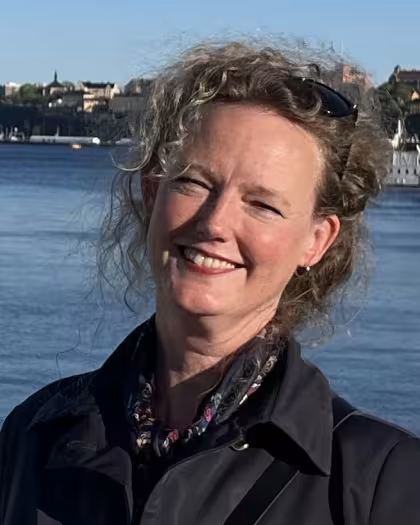
Anna Mariana Bohlin
Position
Professor, Nordic literature
Affiliation
- anna.bohlin@uib.no
- Phone number
- +47 55583703
- Visitor address
-
Sydnesplassen 7
5007 Bergen - Postal address
-
P.O. Box 7805NO-5020 BergenNorway
Anna Mariana Bohlin
Position
Professor, Nordic literature
Affiliation
Research
My research focusses on the intersection of literature and politics, particularly in Nordic 19th-century literature. Several cross-disciplinary fields of research are included in my research interests: nationalism studies, research on pilgrimage, the history of emotions, and above all gender theory – 19th- and early 20th-century gender theories as an object of study and modern gender theories an analytical tool. Nordic literature in a comparative perspective is the core of my research, and the gender perspective an important driving force.
Lately, I have been working on my own research project, Enchanting Nations: Commodity Market, Folklore, and Nationalism in Scandinavian Literature 1830–1850 (funded by Riksbankens Jubileumsfond 2016–2018), I have been the head editor of the cross-disciplinary anthology Nineteenth-Century Nationalisms and Emotions in the Baltic Sea Region: The Production of Loss (Brill, 2021), and participated in the cross-disciplinary research project Tracing the Jerusalem Code: Christian Cultures in Scandinavia (funded by NFR 2015–2018, head project leader Kristin M. Bliksrud Aavitsland).
My PhD thesis, The Anatomy of Voice: Readings of Politics in Silverforsen by Elin Wägner, the Löwensköld trilogy by Selma Lagerlöf, and Klara Johanson’s Causeries in Tidevarvet (2008), investigates the notion of voice, elaborated in literary texts of the 1920s by prominent Swedish feminist writers, in relation to women’s suffrage, finally granted to Swedish women in 1921. Contemporary gender theories by Ellen Key, Mathilde Værting, Rosa Mayreder, Charlotte Perkins Gilman, Alexandra Kollontay, and Olive Schreiner form a context for the relations between voice, corporeality and emancipation developed in the novels and causeries. The study proposes a new metatheoretical model for emancipation theories instead of the heavily criticised distinction between essentialism and constructivism, by focussing the relation between corporeality and meaning, and using tropes of rhetoric to analyse these relations.
Publications
Academic book chapter
Academic article
Academic monograph
Editorial/Leader article
Book anthology
Popular science book chapter
Popular science article
Journal review
Academic literature review
Introduction
Academic commentary
Selected publications:
Publications in the research project Enchanting Nations
”Den svenska 1840-talsromanen som nationell kartografi”, Samlaren 2016, årg. 137, pp. 58–86.
”Female Citizenship in Scandinavian Literature in the 1840s”, Rethinking Scandinavia – CSS Publications Web Quarterly vol 2 2018:1.
”Magi och nation. Häxor i finländsk och svensk 1800-talslitteratur”, Historiska och litteraturhistoriska studier 93, Svenska litteratursällskapet i Finland, Helsingfors 2018, pp. 47–78.
https://doi.org/10.30667/hls.66680
”Nationalistiska utsöndringar: kroppsvätskor hos Wergeland och Almqvist”, Edda 2021:2, årg. 108, pp. 114–127 https://doi.org/10.18261/issn.1500-1989-2021-02-04
“The Novel Reconsidered: Emotions and anti-realism in mid-19th-century Scandinavian literature”, Nations and Nationalism vol. 27, 2021:3 (July), pp. 831–845.
”Inledning: Nation som kvalitet”, Nation som kvalitet: Smak, folk och offentligheter i 1800-talets Norden, Alvheim & Eide Akademisk forlag, eds. Anna Bohlin & Elin Stengrundet, Alvheim & Eide Akademisk forlag, 2021, pp. 8–22.
”Fattigdom som svensk estetik – från Almqvist till IKEA”, Nation som kvalitet: Smak, offentligheter och folk i 1800-talets Norden, eds. Anna Bohlin, & Elin Stengrundet, Alvheim & Eide Akademisk forlag, 2021, pp. 43–64.
Other publications
”Neglect, grief, revenge: Finland in Swedish nineteenth-century literature”, Nineteenth-Century Nationalisms and Emotions in the Baltic Sea Region: The Production of Loss, eds. Anna Bohlin, Heidi Grönstrand & Tiina Kinnunen, Leiden & Boston: Brill, 2021, pp. 80–107.
Bohlin, Anna, Grönstrand, Heidi & Kinnunen, Tiina, ”Introduction: The Production of Loss”, Nineteenth-Century Nationalisms and Emotions in the Baltic Sea Region: The Production of Loss, Leiden & Boston: Brill, 2021, pp. 1–22.
”Geography of the Soul – History of Humankind: the Jerusalem Code in Bremer and Almqvist”, Tracing the Jerusalem Code. Volume 3. The Promised Land: Christian Cultures in Modern Scandinavia (ca. 1750–ca. 1920), eds. Ragnhild J. Zorgati & Anna Bohlin, DeGruyter: Berlin, 2021, pp. 360–389.
”God’s Kingdom on Earth: Liberal Theology and Christian Liberalism in Sweden”, Tracing the Jerusalem Code. Volume 3. The Promised Land: Christian Cultures in Modern Scandinavia (ca. 1750–ca. 1920), eds. Ragnhild J. Zorgati & Anna Bohlin, DeGruyter: Berlin, pp. 540–549.
Bohlin, Anna & Ragnhild Johnsrud Zorgati, ”Introduction: Jerusalem in Modern Scandinavia”, Tracing the Jerusalem Code. Volume 3. The Promised Land: Christian Cultures in Modern Scandinavia (ca. 1750–ca. 1920), red. Ragnhild J. Zorgati & Anna Bohlin, DeGruyter: Berlin, 2021, pp. 12–50.
”Jerusalem in Every Soul: Temporalities of Faith in Fredrika Bremer’s and Harriet Martineau’s Travel Narratives of Palestine”, Time and Temporalities in European Travel Writing, eds. Paula Henrikson & Christina Kullberg, Routledge: London & New York 2021, pp. 182–209.
”Nils and the Social Mother as a Migrating Goose”, Tijdschrift voor Skandinavistiek 36, 2018/2019, pp. 117–124.
”Fredrika Bremer’s Concept of the Nation During her American Journey”, Ideas in History 2013:1-2, pp. 43–70.
”Att tänka med alla sinnen. Aforismen och K. J.”, Tidskrift för litteraturvetenskap 2013:2, pp. 49–59.
”Mårbacka: Larders, cow-houses and other spiritual matters”, Re-Mapping Lagerlöf: Performance, intermediality and European transmissions, eds. Helena Forsås-Scott, Lisbeth Stenberg & Bjarne Thorup Thomsen, Nordic Academic Press: Lund 2014, pp. 60–73.
”Den manliga frimodigheten. Gud och andra män hos Fredrika Bremer”, Kvinnorna gör mannen. Maskulinitetskonstruktioner i kvinnors text och bild 1500–2000, eds. Kristina Fjelkestam, Helena Hill & David Tjeder, Makadam förlag: Göteborg & Stockholm 2013, pp. 310–342.
”I författarens fotspår – litteraturvetenskaplig metod på fältet”, Humanister i fält. Metoder och möjligheter, eds. Åsa Arping, Christer Ekholm & Katarina Leppänen, LIR.skrifter.varia: Göteborg 2016, pp. 23–38.
Röstens anatomi. Läsningar av politik i Elin Wägners Silverforsen, Selma Lagerlöfs Löwensköldtrilogi och Klara Johansons Tidevarvskåserier, diss. Umeå, Bokförlaget h:ström: Umeå 2008.
Projects
Enchanting Nations: Commodity Market, Folklore and Nationalism in Scandinavian Literature 1830–1850 (funded by Riksbankens Jubileumsfond 2016–2018)
The aim of the project is to break up the nationalism of today from within the history of nationalism itself. Fundamental issues - the distinguishing features of the nation, the Christian conception of the nation as an evolutionary step to unite humankind, Scandinavianism, and indeed the very incentive to formulate a nation - prove nationalism of the early 19th century to be foreign to us. Literature was central to the way in which nationalism spread and evoked emotions; nevertheless, popular authors such as the Swedish Fredrika Bremer (1801–1865) have not been investigated in the light of modern, critical theory. Studies of nationalism, on the other hand, have for a long time tended to neglect women. To investigate the development of nationalism through literature makes women’s contributions visible and opens up for an thorough analysis of how women’s citizenship was negotiated. Furthermore, in the Nordic countries, the nation was constructed in relation to a common Old Norse literature, to political connections and conflicts over a long period of time, and to Scandinavianism as a political and cultural movement. The study of nationalism is necessarily transnational, and that applies particularly to Scandinavia.
The research project explores the following research questions: What did the nation signify? What separates and what unites the idea of the nation in Norwegian, Swedish, and Finnish literary texts? How are Christianity, Old Norse myth and folklore related to the concept of the nation? How is consumerism connected to national consciousness? How is citizenship understood in relation to gender? How does literature partake in engendering an affective economy of nationalism?
(Brill, 2021)
A sense of loss is a driving force in most nationalist movements: territorial loss, the loss of traditions, language, national virtues, or of a Golden Age. But which emotions charged the construction of loss and how did they change over time? To what objects and bodies did emotions stick? How was the production of loss gendered? Which figures of loss predated nationalist ideology and enabled loss within nationalist discourse? 13 scholars from different backgrounds answer these questions by exploring nationalist discourses during the long nineteenth century in the Baltic Sea region through political writings, lectures, novels, letters, paintings, and diaries.
(funded by NFR 2015–2018, head project leader Kristin M. Bliksrud Aavitsland).
I am the co-editor of volume 3, , red. Ragnhild J. Zorgati & Anna Bohlin, DeGruyter: Berlin