

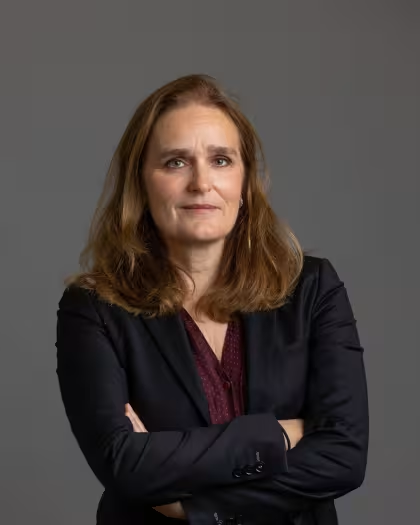
Ragnhild M酶lster
Stilling
Forsker
罢颈濒丑酶谤颈驳丑别迟
- E-post
- ragnhild.molster@uib.no
- Telefonnummer
- +47 55589140
- 叠别蝉酶办蝉补诲谤别蝉蝉别
-
Fosswinckels gate 6
5007 Bergen - Rom: 528
- Postadresse
-
Postboks 7802
5020 Bergen
Ragnhild M酶lster
Stilling
Forsker
罢颈濒丑酶谤颈驳丑别迟
Forskergrupper
- Forskningsgruppen for retorikk, demokrati og offentlig kultur
- Gruppe for journalistikkforskning
- Group for journalism studies
- Research group for rhetoric, democracy and public culture
Forskning
Retorikk, medier og helse, politisk kommunikasjon, offentlighet og demokrati, dokumentar, journalistikk, kj酶nn og medier.
Forsker p氓 diskursiv forhandling av ethos i helsemyndighetenes kommunikasjon under korona-pandemien.
Tilknyttet prosjektet , medier og antibiotikaresistens.
og "Pandemic rhetoric" ()
Prosjekter
CAMRIA - Combatting Anti-Microbial Resistance (AMR) with Interdisciplinary Approaches
The COVID-19 pandemic is a case study on how swift (mis)information and communication can change people's attitudes and behaviors. It led to improved adherence to infection prevention and control (IPC) measures among the public and healthcare workers (HCWs). The pandemic of antimicrobial resistance (AMR) has not elicited the same level of interest nor behaviour change. However, it also presupposes some needed changes in attitudes and behaviors to contain it, such as improved adherence to IPC measures and antibiotic prescribing practices and use. Thus, it is of interest to understand how people's beliefs and attitudes are formed, and how their perception of risk connected to AMR and their willingness to act, can be an important determinant of citizen behavior and policy influence.
We need to study communication on AMR in media over time to get a better understanding of HCWs' and citizens鈥� knowledge, attitudes and risk perception of AMR, along with their motivation to act. This knowledge is needed in order to bring about needed change in behaviors, both among the general public and healthcare workers.
Our three main research questions are:
- What is the perception of the AMR-related risk among HCWs and how willing are they to act to the AMR and COVID-19 pandemics (with focus on the influence of different sources of information)?
- How does the public鈥檚 knowledge of - and attitudes towards AMR, along with their willingness to act, compare to similar existing data on the COVID-19 pandemic and the climate crisis?
- Has the framing of AMR in selected online news media and debated through the spread in social-media changed over time, and if so, how?
The knowledge gained from this project will enable the development of improved health policies and communication based interventions, which intentionally will promote desirable behaviour changes and thereby contain AMR.
The project applies a mixed methods approach. In Work Package 1, we will perform focus group interviews with healthcare workers, using a semi-structured interview guide. The data will consist of the interviewees鈥� quotes and expressions from which we will extract themes related to risk perception and motivation of action and change of behavior. In Work Package 2, AMR-related questions are a part of the citizen panel survey. Data, comprising of participants' answers, will be analyzed with the use of quantitative methods, and provide information as to suggest remedies specific for decision makers at macro- (politicians/ bureuacrats), meso- (health sector leaders) and micro- level (individual health care workers). Work Package 3 will explore how media audiences experience risk in the coverage of AMR, and accept, refuse or negotiate the framing of AMR in the news. Retrospective analyses will provide a framing of AMR in selected online news media over the past 10 years, through both quantitative and more detailed qualitative rhetorical analyses, to uncover the rhetoric and argumentative structures of the mediated debate and communication on AMR, and possible historical changes.
Retorikk om pandemi.
2019-2023
The relations between migration policy and mediated public discourse in Scandinavia 1970-2015
This project studies the relationship between the public debate and political decisions on immigration in the three Scandinavian countries. How does public opinion, as expressed through the public debate in media and arts, influence political decisions? What are the differences between the countries, and how has the relationship developed over the past 45 years?
Through analyses of policy documents, parliamentary debates and interviews with Scandinavian politicians, public servants and communication officers, the projects will seek to identify and understand links between public debates and political decision-making in Scandinavia during the past 45 years.