

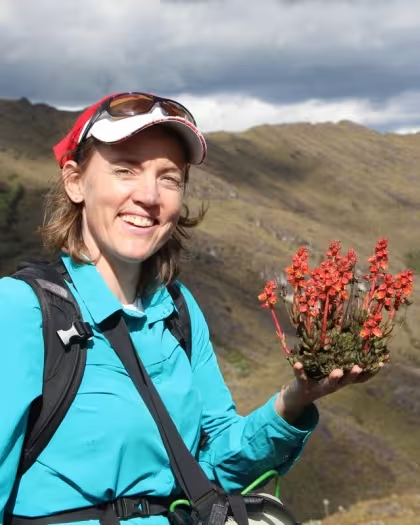
Suzette Flantua
Position
Researcher, Leader of mountains in motion - research group
Affiliation
- suzette.flantua@uib.no
- Visitor address
- Room: 2B18
- Postal address
-
P.O. Box 7803NO-5020 BergenNorway
Follow me
Suzette Flantua
Position
Researcher, Leader of mountains in motion - research group
Affiliation
Research groups
Short info
Research
My main research interest is to understand what determines biodiversity in mountain regions, by studying the impact of climate dynamics at various time scales (past, present, future). I am particularly interested in the way how historical environmental factors (climate and geology) and humans influenced contemporary biodiversity patterns. I have a strong backgroung in spatial analysis using GIS and Remote sensing in a range of different topics in macroecology, biogeography and palaeoecology. Most of my work has dealt with mountains and the tropics where I also have organized and participated in numerous field expeditions of the Northern and Central Andes, and savanna lowlands. I also supervise students and lecture in courses, organize scientific events, and take responsibility in committees. In addition, I am passionate about communicating my research to a broader audience through the use of video (see Communication) and talks about sustainability.
Since April-2022 I am leading the lab called the Mountain in Motion, funded as a Startup Grant by Trond Mohn Foundation and the Dept of Biological Science, 黑料吃瓜资源. The aim of the lab is to understand present-day mountain biodiversity from a short and long-term perspective and link expertise from biosphere, geosphere, cryosphere, and atmosphere to move our understanding of these regions forward to better conserve them in the future.
See here more for information on the projects and the team:
Outreach
PUBLIC OUTREACH:
- Publication 鈥淢inienciclopedia del Paramo鈥�: Together with an interdisciplinary team that comprises artists, science communicators, evolutionary biologists, and ecologists has crafted a scientific children鈥檚 book on the alpine ecosystems of the northern Andes. ,
- Participation in Environmental film festivals:
- 鈥楽ky islands: A time travel of the Andes Mountains鈥� by C. Giraldo, S.G.A. Flantua, and H. Hooghiemstra ()
- Official Selection at international festivals screened in Angola, Australia, Brazil, Burkina, Colombia, Faso, Ethiopia, Hungary, Kenya, Malaysia, Namibia, Philippines, Rwanda, South Africa, United States.
- Awards:
- Honorable Mention in the first edition of #EcoBrasil Fest. 22-29 April 2021.
- Best Life Sciences Documentary of the #Sci-On Film Festival The Biggest Little Science + Fiction Film Festival in the World. 4-9 May 2021.
- Excellence #Nature Without Borders International Film Festival, Nassau, Delaware, United States. 6 June, 2021.
- Open Day Amsterdam Science Park. Amsterdam, The Netherlands (2018). 鈥楽ky islands: A time travel of the Andes Mountains鈥�. Short movie.
- Youtube video (>10,000 views), on the biogeographical history of the high Andean p谩ramos during the last 1 million years (2017)
- Open Day Amsterdam Science Park. Amsterdam, The Netherlands (2016). 鈥楩ieldwork through time: From microscopes to mountain tops鈥�. Presentation.
- Forum for the regional planning of sustainable oil palm production in Colombia. Bogot谩, Colombia. (2016). 鈥楲andscape connectivity at a regional scale鈥� (In Spanish). Presentation.
MEDIA COVERAGE:
- Publications featured on websites of University of Amsterdam, Smithsonian Tropical Research Institute website, University of Bergen and Bjerknes Centre for Climate Research
- Papers featured in newspapers and scientific websites: Science paper () on rates of change caused by humans in the Amazon basin, Science paper () on global rates of vegetation change, Journal of Biogeography paper () on the biogeographic history of the Andean p谩ramos, Nature Geoscience paper () on mountain biodiversity, and Science paper (2015) on the closing of the Panama Isthmus ().
- My work featured in
- Opinion piece published in Norwegian newspaper Dag og Tid (Norwegian) on 鈥淐ritical transitions in the Amazon forest system鈥� in Nature (). .
- Radio interviews:
- NPO radio (Dutch): About our paper in Science 2023 on the Amazonian rates of change.
- BBC Inside Science. . (May 2021)
- BBC Vroege Vogels. Birding and research in Norway (Dec 2020)
- BBC Radio 4. Interview and report on fieldwork expeditions in Colombia. Boyac谩 Plants-for-life project. Royal Botanical Garden Kew, UK (Feb 2018)
Teaching
University of Bergen
- Teacher on Macroecology in BIO301A Current Topics in Biodiversity, Evolution and Ecology
- Participant in UPED659B 25H / Leveraging Large Language Models and Artificial Intelligence for Teaching and Learning (15 hours)
- Participant in UPED600E 25V Course 鈥業ntroduction to Teaching at University and Course Design鈥� in the Program of University Pedagogy, University of Bergen.
- Participant in Workshop 鈥業ntroduction to Teaching and Course Design鈥� and 鈥楨ffective Supervision鈥� (15h) in the Program of University Pedagogy, University of Bergen.
University of Amsterdam
- Practicum assistant GIS and Geospatial analysis, Bachelor course Digital Earth, Future planet studies, University of Amsterdam
- Practicum assistant GIS, Geospatial analysis and Databases, Bachelor course Biodiversity & Global Change, Biological Sciences, University of Amsterdam
- Lecturer Bachelor course Biodiversity & Global Change, Biological Sciences, University of Amsterdam
- Lecturer, practicum and field work assistant, Bachelor course Palaeoecology, Biological Sciences, University of Amsterdam
Colombia
- Coordinator and lecturer, Master course 鈥業ntroduction to environmental information systems at national and international level, GIS and Remote Sensing鈥� including a hands-on workshop on the use of Quantum GIS. (In Spanish). In collaboration with M. Romero, 4D Elements Consultores, University of Tunja, Colombia.
- Coordinator and lecturer, Master course 鈥業ntroduction to environmental information systems at national and international level, GIS and Remote Sensing, with emphasis on environmental management in the Orinoco basin鈥�. (In Spanish) In collaboration with M. Romero, 4D Elements Consultores. Universidad de los Llanos, Colombia.
- Coordinator and lecturer, Pre-congress training course 鈥楥hronology and integration of spatial and temporal data in paleo-environmental interpretations鈥�, LOTRED 鈥揝A Symposium. Medellin-Colombia
- Coordinator and lecturer, Workshop 鈥楥apacity building in Biotechnology and Bio-security. Impacts and opportunities for socio-ecosystems鈥� (In Spanish). 4D Elements Consultores 鈥� NGP Seguridad Alimentaria 鈥� SENA. Bogot谩-Colombia.
- Coordinator online courses. Introduction to Sustainability; Sustainable landscape design. (In Spanish). Asesor铆as de Dise帽o Sostenible. Medellin-Colombia.
- English Teacher, ESL Institute. Manizales, Colombia.
Publications
2021
2018
2023
2024
2020
2022
2019
2025
Projects
PAST, PRESENT, AND FUTURE OF ALPINE BIOMES WORLDWIDE - PPF-ALPINE
PPF-Alpine is a ongoing project aiming to develop a mechanistic understanding of the role of the dynamic past in shaping present-day patterns of mountain biodiversity, sourcing and integrating knowledge from a range of different disciplines. Funded by the Trond Mohn Foundation (TMS) and University of Bergen.
GLACIMONTIS
GLACIMONTIS is an ongoing research project dedicated to understanding the extent of mountain glaciers during past cold periods, with a focus on the Last Glacial Maximum (~21,000 years ago) and the last glacial cycle (the last 130,000 years). The project reconstructs glaciers in mountains worldwide with cutting edge techniques and compiles paleoglacier reconstructions from published studies into a global open-access geodatabase, integrating geomorphological mapping, chronological data, and glacier modelling outputs.
CONNECT-EVOLVE
This project brings together expertise in ecology, evolutionary biology, and climate science to uncover how past climate changes and the rugged Andean topography influenced the distribution and diversification of plants in the p谩ramo. By integrating cutting-edge models, genetic insights, and detailed plant records, we aim to shed light on the historical forces that generated such spectacular richness. We will look into the relationship between dispersal modes from several "paramo" plants, their phylogenies, and their biogeographical histories.
ECO-SPACE
ECO-SPACE is a project aimed to our students at BIO and 黑料吃瓜资源 to address a critical gap in Norway鈥檚 higher education: the lack of geospatial training for biology and environmental science students that integrates Universal Design (UD) principles. This project aims to develop educational material that will combine GIS, Remote Sensing, and spatial analysis with ecological and environmental applications, ensuring that students learn to create accessible, inclusive, and impactful geospatial products.
GEO-BRIDGE: 黑料吃瓜资源 collaborative platform for GIS/RS methods in landscape analysis in a changing world
GEO-BRIDGE currently brings together researchers from the UIB, spanning the Departments of Earth Science, Biology, Geography, Physics, and Archaeology鈥攔epresenting three faculties. For projects, monthly seminars and workshops, we have established a collaborative partnership with the Theoretical and Computational Ecology group at the University of Amsterdam (UvA). See more here:
The Mini-Encyclopedia of the P谩ramos
An interdisciplinary team that comprises artists, science communicators, evolutionary biologists, and ecologists has crafted a scientific children鈥檚 book, 鈥�鈥�. This book, distributed free thanks to local institutions, blends art and science to educate about the alpine ecosystem in the high-elevation areas of the Northern Andes, across Venezuela, Colombia, and Ecuador. 鈥淟a Minienciclopedia del P谩ramo鈥� aims to share scientific knowledge for young minds. With financial support from in Amsterdam, we have distributed >1000s books in Colombia this year and we will work on a translation to Dutch, English, and Norwegian.
COLLABORATIONS
DRONE-WILLOW-BUMBLEBEE project
This project uses drone-based remote sensing and fieldwork at Finse, Norway, to map male and female willow density and link it to bumblebee abundance, to understand how climate-driven shrub expansion impacts alpine biodiversity and ecosystem dynamics. Led by 脴rjan Totland (BIO-黑料吃瓜资源) in collaboration with Ben Robson (Department of Earth Science)
BIODYNAMICS
The BIODYNAMICS project aims to address the need for predicting biodiversity and ecosystem alteration under global climate change. By investigating local processes of species interactions, BIODYNAMICS will contribute crucial insights into how these interactions shape continental and global biodiversity patterns over the past 20 thousand years (ka). BIODYNAMICS will develop innovative approaches that allow estimating ecosystem functioning, especially the essential biotic interactions, at 3 major ecological scales (spatial, temporal, and taxonomic), spanning from individual plants in local sites to whole continents and from 20 ka to the present. Led by . See