

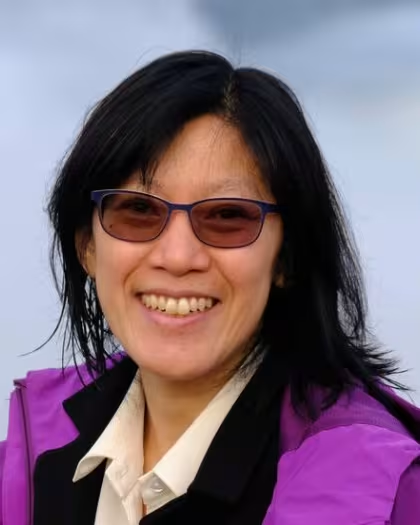
Mimi E. Lam
Position
Researcher, Marie sk艂odowska-curie alumna
Affiliation
- mimi.lam@uib.no
- Phone number
- +47 55582614
- +47 484 04 622
- Visitor address
-
Parkveien 9
5007 Bergen - Postal address
-
P.O. Box 7805NO-5020 BergenNorway
Mimi E. Lam
Position
Researcher, Marie sk艂odowska-curie alumna
Affiliation
Research groups
Research
I am a transdisciplinary scholar. I work across disciplines and cultures, typically in collaborative teams, to solve complex problems. As a theoretical chemist and physicist, I analyzed physical problems in the quantum and statistical realms, notably at surfaces. Applying analytical insights and methodological approaches from the physical sciences, I now study the complex interactions and underlying mechanisms governing social-ecological systems, specializing in fisheries. I investigate human values, beliefs, identities, and behaviours not only to resolve today's grand societal challenges, but also to gain insights of our evolutionary past and to inform ethical decision-making for a more sustainable and just future. To do this, I collaborate with scientists from various disciplines (e.g., ecology and philosophy) and citizens and stakeholders with diverse perspectives and knowledge (e.g., local and indigenous communities, industry, NGOs, and government).
I currently investigate three related themes:
- Marine values and identities in fisheries and seafood value chains.
- Marine sustainability, policy, and governance, notably of seascapes.
- Participatory research at the marine science-society-policy nexus.
Current positions
- Researcher, University of Bergen, Centre for the Study of the Sciences and the Humanities
- Affiliate Assistant Professor, University of British Columbia, Institute for the Oceans and Fisheries, Policy and Ecosystem Restoration in Fisheries Research Unit
- Associate, University of British Columbia, Centre for the Study of Human Evolution, Cognition, and Culture
- Adjunct Associate Professor, University of New Mexico, Department of Biology
- Marie Curie Alumnus, European Commission
- Senior Fellow, Environmental Leadership Program
Outreach
My research has been featured in various mainstream news and social media outlets.
Most recently, the national media in the United States (), Canada (), Norway (), France (), Greece (), India (, ), and Argentina () have profiled my research into , published in . According to the , my article is trending in online media attention, with an altmetric score of 202, placing it in the 99th percentile of tracked articles of a similar age in all journals. This research is part of my project.
My Marie Sk艂odowska-Curie Individual Fellowship project on was profiled in a , which highlighted a workshop I organized on the Ethics of Quantification in Bergen, Norway examining the challenges of trying to quantify aspects of the Norwegian spring-spawning herring fishery and in , where I was interviewed on my views of ecosystem-based management in the context of the Chilean austral sprat fishery.
Prior to coming to the 黑料吃瓜资源, profiled a project that I led to focus on in British Columbia, Canada.
I was also profiled in the and and when I received the and .
A and the student newspaper, , highlighted the that I led combining art and science to research and disseminate the role of herring in the ecosystem, communities, and industry in British Columbia.
The was a fun event, akin to 鈥渟peed-interviewing,鈥� where I was interviewed by the audience!
As well, there are a number of profiles and features related to my earlier work with indigenous communities in the United States and various symposia that I organized for the American Association for the Advancement of Science.
I have also written popular articles to disseminate my research more broadly to the public, most notably in .
Media coverage
, Inc., 11 Feburary 2021.
, 640 Toronto鈥檚 Morning Show with Peter Shurman, 10 February 2021.
, AFINO blog, 10 February 2021.
, The National Post, 5 February 2021.
, TV2, 4 February 2021.
, Big Think, 2 February 2021.
, The Indian Express, 2 February 2021.
, Clarin, 1 February 2021.
, Ta Nea, 1 February 2021.
, L'Express, 1 February 2021.
, The Hindu Business Line, 30 January 2021.
! EurekAlert, 29 January 2021.
, The Sealives Initiative, 17 February 2019.
, SUBPESCA Publicado, 13 November 2018.
, Ethical, Legal and Social Aspects (ELSA) blog, 6 August 2018.
, University of Bergen, 15 November 2017.
, SCB News Blog, 27 July 2017.
, University of Bergen, 13 June 2017.
, University of British Columbia, 1 June 2017.
, The Ubyssey, 5 April 2017.
Herring People, Roundhouse Radio Interview, 29 March 2017.
, University of British Columbia, 24 March 2017.
, WWF-Canada and the Ecology Action Centre Reception, ICES/PICES Dynamics of Small Pelagic Fish Symposium, 9 March 2017.
, University of British Columbia, Peter Wall Institute for Advanced Studies, The Wall Papers: Peter Wall Institute Magazine, Spring 2016.
Gyotaku: Creating Life from Death: The Japanese Art of Fishprinting, CBC Radio One Early Edition with Rick Cluff interview with Mineo Ryuka Yamamoto, 28 July 2011.
Two Worlds Working Together: Forming a Link between Traditional Knowledge and Western Science, Cassandra Brooks, Society for Advancing Hispanics/Chicanos & Native Americans in Science (SACNAS) News, Summer/Fall 2009, Vol. 12(1), pp. 4 鈥� 7.
Climate Change and Indigenous Knowledge, Richard Simonelli, Winds of Change: American Indian Education & Opportunity, Summer 2008, Vol. 23(3), pp. 18 鈥� 22.
Report on AAAS Symposium, The Privilege to Fish, in West Coast Fisheries Need Better Management, by Graeme Stemp-Morlock, Green Living Online, 28 February 2008. [online] URL: http://www.greenlivingonline.com/Business/west-coast-fisheries-need-better-management/.
Report on AAAS Symposium, The Mind of a Toolmaker, in How Human Intelligence Evolved 鈥� Is it Science or 鈥橮aleofantasy鈥�, by Michael Balter, Science News Report, 22 February 2008, Vol. 319, p. 1028.
Report on AAAS Symposium, The Privilege to Fish, in AAAS: Cod, Tuna, Sharks, and the Privilege to Fish on The Shifting Baselines blog by Jennifer L. Jacquet, 18 February 2008. [online] URL: http://scienceblogs.com/shiftingbaselines/2008/02/aaas_cod_tuna_sharks_and_the_p.php.
Fostering Connections, Cassandra Brooks, Winds of Change: American Indian Education & Opportunity, Autumn 2007, Vol. 22(4), pp. 30 鈥� 31.
Commentary of Paleo-doodles and Places: A Proto-symbolic Stage in Human Evolution? AAAS presentation, in In the Field: AAAS: Paleodoodling, by Heidi Ledford, Nature blog, 20 February 2007. [online] URL: http://blogs.nature.com/news/blog/2007/02/aaas_paleodoodling.html.
Interview on AAAS Presentation, A Historical Gedanken of Human Learning, Radio Nederland Wereldomroep, The Research File, by J. M. A. Westerbeek van Eerten, Producer, 18 May 2005.
Popular articles
, The Vancouver Sun, 9 November 2015.
Building Sustainable and Resilient Communities, Locally and Globally, FishBytes: The Newsletter of the Fisheries Centre, UBC 14(6):3, 2008.
Valuing Diverse Ways of Knowing, Winds of Change: American Indian Education & Opportunity, Summer Issue, 23(3):42 鈥� 46, 2008.
The Privilege to Tuna, FishBytes: The Newsletter of the Fisheries Centre, UBC 14(2):2, 2008.
What is Nature? FishBytes: The Newsletter of the Fisheries Centre, UBC 13(5):1 鈥� 2, 2007.
Fishprinting Workshop: The Japanese Art of Gyotaku, FishBytes: The Newsletter of the Fisheries Centre, UBC 13(5):3, 2007.
UBC Aboriginal Fisheries Logo Contest Winner, FishBytes: The Newsletter of the Fisheries Centre, UBC 12(5):3, 2006.
Salish Sea Gathering: Towards Ecosystem-based Governance of the Salish Bioregion, FishBytes: The Newsletter of the Fisheries Centre, UBC 11(6):4 鈥� 5, 2005.
Teaching
Statement of teaching interests
To train a new generation of socially responsible scientists and citizens, I believe that my main role as an educator is to facilitate learning and the transfer of concepts that students can apply directly to their lives. I do that by designing interdisciplinary, theme-based courses that are respectful of individual learning styles and culturally contextualized to embrace diverse ways of knowing. My primary objective in the classroom and in my professional interactions is to foster reciprocal teaching and learning experiences, creating research and cultural mentoring opportunities using insights from cognitive and educational research.
Student supervision and mentoring
Sahir Advani, University of British Columbia (UBC), Institute for the Oceans and Fisheries (IOF), PhD, How Commoditization and Cross-cultural Values Influence the Sustainability of Small-scale Fisheries in the Andaman and Nicobar Islands, India (2014 鈥� 2020)
Jeff Scott, UBC, IOF, MSc, (2014 鈥� 2017)
Audrey Tung, UBC, IOF, Undergraduate Researcher (2015 / 2016)
Diverse students under-represented in ecology, Ecological Society of America, Strategies for Ecology Education, Diversity and Sustainability (SEEDS) Mentor (2004 - 2008)
Curricular innovations
The Evaluation of Fisheries Status, Austral Summer Institute XVII, University of Concepci贸n, Chile (2017): Co-designed 1-week intense course to fisheries graduate students and professionals, largely from Chile, Peru, and Ecuador.
Governance Module (including Fishing Game), Fisheries Conservation, Governance and Evaluation course, UBC, Canada (2011): Designed game to teach graduate students of diverse fishing values along seafood value chain in fisheries governance module co-designed and co-taught.
Native American and Pacific Islander Research Experiences (NAPIRE) Program, Organization for Tropical Studies, Duke University, Costa Rica (2006): Tropical biology research and cultural experiences eight-week summer program in Costa Rica for Native American and Pacific Islander undergraduate students.
Biology 104: Natural and Cultural History of the Salish Bioregion, Northwest Indian College (NWIC), USA (2004): experiential course integrating marine science and traditional ecological knowledge of Salish Bioregion, in collaboration with the University of Washington-Friday Harbor Laboratories.
Mathematics 101: Mathematics in Nature, Art, and Life, NWIC, USA (2003): conceptual, experiential, holistic mathematics course promoting quantitative literacy within a collaborative learning environment respectful of students鈥� identities, cultural perspectives, and traditional ecological knowledge.
Science 101: Encounters in the Sciences, NWIC, USA (2002): integrated, contextual, experiential survey course of physical and life sciences, building scientific literacy by integrating cultural history and traditional knowledge within learning community; capstone field experiences with US National Parks Service.
Educational research activities
Faculty Team at National Science Foundation (NSF) -sponsored Spreadsheets Across the Curriculum (SAC) Workshop, 鈥嬧�嬧�嬧�婳lympia, WA, USA (2005).
Faculty Team at 3 NSF-sponsored Math Across the Curriculum (MAC) Workshops, 鈥嬧�嬧�嬧�嬧�嬧�婰eavenworth, WA, USA (2002 鈥� 2004).
Sponsored STEM Faculty at 3 NSF-sponsored Project Kaleidoscope (PKAL) Assemblies (2003):
1. Linking Insights about How People Learn to Curricular Reform, Richmond, VA, USA.
2. Ensuring the Success of Under-represented Groups in STEM Learning Environments, Glassboro, NJ, USA.
3. Taking Advantage of New Opportunities for Environmental Research and Education, Portland, OR, USA.
Tribal Colleges and Universities Program (TCUP) Faculty at NSF-sponsored Foundations of Technology Summer Institute: Designing Integrated Curricula, Syracuse, NY (2002).
Indigenous Cultures and Ecology Faculty, Portland International Initiative for Ecology, Culture, and Learning Leadership for Sustainability Workshop, Portland, OR (2002).
Courses taught
Co-instructor (team taught with fisheries biologist), The Evaluation of Fisheries Status, Austral Summer Institute XVII, University of Concepci贸n, Chile (2017)
Guest Lecturer, Fisheries (FISH) 520: Fisheries Conservation, Governance and Evaluation, UBC, Canada (2011 - 2015)
Guest Lecturer, Earth and Ocean Sciences (EOSC) 478: Introduction to Fisheries Science, UBC, Canada (2010 - 2011)
Guest Lecturer, Interdisciplinary Studies (INDS) 530: Methodologies of Crossing: Exploring Interdisciplinary Knowledges, Trajectories, and Worldviews, UBC, Canada (2010)
Coordinator, Native American and Pacific Islander Research Experiences (NAPIRE) Program, Organization for Tropical Studies, Duke University, Costa Rica (2006)
Co-instructor (team taught with 5 STEM faculty), Science 101: Encounters in the Sciences, NWIC, USA (2002 鈥� 2003)
Co-instructor (team taught with 1 Mathematics faculty), Mathematics 101: Mathematics in Nature, Art, and Life, NWIC, USA (2003)
Instructor, Mathematics 99: Intermediate Algebra, NWIC, USA (2002 鈥� 2003)
Instructor, Mathematics 107: Elementary Statistics, NWIC, USA (2002)
Instructor, Chemistry 111/112/113: Inorganic, Organic, and Biological Chemistry, NWIC, USA (2002 鈥� 2003)
Instructor, Chemistry 100: Introductory Chemistry, NWIC, USA (2002)
Instructor, Chemistry 121: General Chemistry, NWIC, USA (2002)
Instructor, Chemistry 121 and 122: General Chemistry I and II, Whatcom Community College, USA (2001 鈥� 2002)
Teaching Assistant, Chemistry 2301/2302: Physical Chemistry, Dalhousie University, Canada (1992 鈥� 1994)
Teaching Assistant, Chemistry 1011: Introductory Chemistry, Dalhousie University, Canada (1990 鈥� 1992)
Publications
Academic article
Professional article
Letter to the editor
Conference lecture
My research is situated at the science-society-policy nexus, spanning the physical, ecological, and human sciences. I have published in journals ranging from Science, Frontiers in Ecology and the Environment, to Humanities and Social Sciences Communications. My academic career has been unconventional, with spurts and gasps, as I enter new domains of inquiry to radically challenge my pre-existing paradigms. Rather than be an expert of only one discipline, I am a transdisciplinary scholar attracted to interfaces, be they between states of matter, disciplines or cultures. Arthur Koestler wrote that creativity in humour, science, and art arises from perceiving a situation or idea in two self-consistent, but habitually incompatible frames of reference. I am honing my dual competency in the sciences and humanities, notably ethics, to forge viable, just, and lasting solutions to today's grand societal and environmental challenges.
Journal articles and book chapters
Human Ecology and Fisheries Ethics
Lam, M. E. 2021. , Humanities and Social Sciences Communications 8:31.
Kaiser, M., S. Goldson, T. Buklijas, P. Gluckman, K. Allen, A. Bardsley, M. E. Lam. 2021. , Food Ethics 6:4.
Aguado, S. H., I. S. Segado, M. E. S. Vidal, T. J. Pitcher, M. E. Lam. 2021. , Marine Policy 124:104280.
Lam, M. E. 2019. , Pp. 177-197 in B. Fischer (ed): The Routledge Handbook of Animal Ethics: Routledge, NY.
Fetcher, N., M. E. Lam, C. R. Cid and T. Mourad. 2019. , Ecosphere 10(12):e02964.
Lam, M. E., T. J. Pitcher, S. Surma, J. Scott, M. Kaiser, A. S. J. White, E. A. Pakhomov and L. Ward. 2019. , Marine Ecology Progress Series 617-618:341-364.
Johnson, D. S., A. Lalancette, M. E. Lam, M. Leite and S. K. P谩lsson. 2019. , Pp. 35-54 in MARE Publication Series, Vol. 21, R. Chuenpagdee and S. Jentoft (eds): Transdisciplinarity for Small-Scale Fisheries Governance: Analysis and Practice. Springer International Publishing, Switzerland.
Surma, S., T. J. Pitcher, R. Kumar, D. Varkey, E. A. Pakhomov and M. E. Lam. 2018. , PLoS ONE 13(7):e019630.
Raman, S., P. Hobson-West, M. E. Lam and K. Millar. 2018. . Pp. 230-250 in: B Nerlich, S Hartley, S Raman, A Smith (eds), Science and the Politics of Openness: Here Be Monsters. Manchester University Press: Manchester, UK.
Pitcher, T. J., M. E. Lam, M. Kaiser, A. White and E. A. Pakhomov. 2017. . Pp. 112-119 in: P Tortell, M Young, P Nemetz (eds), Reflections of Canada: Illuminating our Opportunities and Challenges at 150+ Years. Peter Wall Institute for Advanced Studies, University of British Columbia: Vancouver, Canada.
Lam, M. E. 2016. , Journal of Agricultural and Environmental Ethics 29(1):35-65 (Special Issue: Selected Papers from the 2013 EurSAFE Conference).
Pitcher, T. J. and M. E. Lam. 2015. , Maritime Studies (MAST) 14(1):1-19.
Lam, M. E. 2015. , Pages 422-437 in: Freshwater Fisheries Ecology, J. F. Craig, ed. (invited). Wiley-Blackwell: Oxford, UK.
Lam, M. E. 2014. , Frontiers in Ecology and the Environment 12(4):250-251 (Special Issue: Eco-literacy: Roles, Responsibilities and Relationships of Ecologists in the 21st Century).
Pitcher, T. J., M. E. Lam, C. Ainsworth, A. Martindale, K. Nakamura, R. I. Perry, T. Ward. 2013. . Journal of Fish Biology 83(4):865-889 (Special Issue: Selected Papers from the Sixth World Fisheries Congress).
Beck, C., K. Klemow, J. Paulson, A. Bernstein, M. Lam, G. Middendorf, J. Reynolds, K. Belanger, C. Cardelus, C. Cid, S. Doshi, N. Gerardo, L. Jablonski, H. Kimmel, M. Lowman, A. Macrae-Crerar, B. Pohlad, J. de Roode, and C. Thomas. 2012. , Science, 335:1301-1302.
Lam, M. E. and M. E. Calcari Campbell. 2012. , Ecology and Society 17(4):19.
Lam, M. E. 2012. , Ecology and Society 17(4):18.
Lam, M. E. and T. J. Pitcher. 2012. , Current Opinion in Environmental Sustainability 4:364-373.
Lam, M. E. and T. J. Pitcher. 2012. , Bulletin of Science, Technology and Society, 32(1):31-40.
Lam, M. E. and T. Borch. 2011. , Pages 361-376 in: Globalisation and Ecological Integrity in Science and International Law, L. Westra, K. Bosselmann, and C. Soskolne (eds.), Cambridge, UK: Cambridge Scholars Publishing.
Lam, M. E. and D. Pauly. 2010. , Ecology and Society 15(3): 16.
Pitcher, T. J. and M. E. Lam. 2010. , Ecology and Society 15(2): 12.
Lam, M. E. and R. Gonzalez-Plaza. 2006. . Journal of Ecological Anthropology 10:66-71.
Theoretical Chemistry and Physics
Gulam Razul, M. S., E. V. Tam, M. E. Lam, P. Linden, and P. G. Kusalik. 2005. , Molecular Physics 103(14):1929-1943.
Lam, M. E., R. J. Boyd and H. J. Kreuzer. 1996. . Chemical Physics Letters 253:129-134.
Hensel, K. D., M. E. Lam, M. C. L. Gerry, and H. Willner. 1992. . Journal of Molecular Spectroscopy 151:184-196.
Le Roy, R. J., M. R. Davies, and M. E. Lam. 1991. . Journal of Physical Chemistry 95:2167-2175.
Lee, N., M. E. Lam, B. C. Sanctuary, and M. A. Keniry. 1991. . Journal of Magnetic Resonance 92:455-467.
Sanctuary, B. C., N. Lee, F. Commodari, G. Campolieti, M. S. Krishnan, and M. Lam. 1989. . Journal of Magnetic Resonance 84:323-332.
Conference proceedings
Lam, M. E., P. Angkiriwang, S. Surma and T. J. Pitcher, Pacific Herring Values and Ethics: Linking Cultures, Fisheries, and Ecology, Proceedings of the Asia-Pacific Society for Agricultural and Food Ethics 2018 Congress, Climate Change and Food: Challenges for the Future, Taipei, Taiwan, May 10 -12, 2018.
Lam, M. E. 2015. Reconciling Haida Ethics with Pacific Herring Management, Pages 169-175 in Know Your Food: Food Ethics and Innovation. Proceedings from the 12th EurSafe Congress, Cluj-Napoca, Romania, 28 鈥� 30 May 2015. D. E. Dumitras, I. M. Jitea, and S. Aerts (eds). Wageningen Academic Publishers: Wageningen, The Netherlands. DOI: http://dx.doi.org/10.3920/978-90-8686-813-1_25.
Lam, M. E. 2013. Comparing the Ethics of Capture Fisheries and Aquaculture, Pages 305-312 in The Ethics of Consumption: The Citizen, The Market, and The Law. Proceedings from the 11th EurSafe Congress, Uppsala, Sweden, 11 鈥� 14 September 2013. H. R枚cklinsberg and P. Sandin (eds). Wageningen Academic Publishers: The Netherlands.
Technical reports
Cohen, J. B., F. Bajanca, M. E. Lam, K. Stroobants, P. Novitzky, M. Bj枚rnmalm, G. Kismih贸k, A. Loeber. 2019. .
Lam, M. E., T. J. Pitcher, S. O. Funtowicz, and J. P. van der Sluis. 2018. Preliminary Knowledge Quality Assessment of ICES Advice for NSSH Fishery. Annex 6, Pp. 90-94 in ICES Report of the Workshop on a Long-term Management Strategy for Norwegian Spring-spawning Herring (WKNSSHMSE), August 2018, Torshavn, Faroe Islands. ICES CM 2018/ACOM: 53.
Kumar, R., S. Surma, T. J. Pitcher, D. Varkey, M. Lam, C. Ainsworth, and E. Pakhomovo. 2016. An Ecosystem Model of the Ocean Around Haida Gwaii, Northern British Columbia: Ecopath, Ecosim and Ecospace. Fisheries Centre Research Reports 24(2):76pp.
Pitcher, T. J., R. Kumar, M. E. Lam, S. Surma, and D. Varkey. 2016. Spatial Modelling of the Haida Gwaii Ecosystem: Contributions to Haida Gwaii Marine Spatial Plan. Fisheries Centre Research Reports 24(1):79pp.
Pitcher, T. J., R. Kumar, M. E. Lam and S. Surma. 2013. Spatial Modelling of the Haida Gwaii Ecosystem: A Pilot Project Contributing to Haida Gwaii Marine Spatial Planning. Report to the Haida Oceans Technical Team, 72pp.
Pitcher, T. J., M. E. Lam, P. Ganapathiraju, A. Martindale, K. Nakamura, R. I. Perry, D. Varkey and T. Ward. 2011. UBC Martha Piper Research Fund Final Report: Valuing the Human Dimensions of Fisheries.
Pitcher, T. J., M. E. Lam, D. Varkey, N. Adams, E. Buchary, B. Hunt, S. Klain, L. Li, S. Obradovich, K. Parkinson, I. McKechnie, D. Tesfamichael, Z. Schoenberger and H. Stewart. 2009. The Sea Before Us: Reconstructing the Strait of Georgia, Peter Wall Institute of Advanced Studies Exploratory Workshop, 29-31 May 2009.
Lam, M. E. and U. R. Sumaila. 2008. Socio-economics Discussion Paper: Proposed revised Multiple Accounts Evaluation Framework emphasizing sociological resilience and community profile indicators, DFO Report.
Gu茅nette, S., V. Christensen, C. Hoover, M. E. Lam, D. Preikshot, and D. Pauly. 2007. A Synthesis of Research Activities at the Fisheries Centre on Ecosystem-based Fisheries Modelling and Assessment with Emphasis on the Northern and Central Coast of BC, Fisheries Centre Research Reports, Vol. 15(1), Fisheries Centre, University of British Columbia, Vancouver, BC, Canada.
See also publication list in Cristin:
Projects
Current projects
Research Council of Norway (2020-2024)
Management of marine resources, globally and in Norway, strives to achieve sustainable development by balancing resource extraction, biodiversity conservation, and societal acceptability. However, these three philosophical paradigms tend to stand as monolithic pillars in their approaches to sustainability, namely: rationalization, conservation, and community. Consequently, such un-integrated approaches tend to lead to management objectives and policy goals in conflict. These conflicts are often rooted in competing economic, ecological, and social values. MENSA鈥檚 overarching aim is to develop an integrated ethical approach to the sustainable management of Norwegian seascape activities: this will be done by making explicit values and valuation of the sea and negotiating the ensuing trade-offs with the input of diverse marine stakeholders in Norway, including scientific experts, government representatives, industry members, non-governmental organizations, and most importantly, its citizens.
MENSA鈥檚 objectives are threefold:
- To contribute to a theoretical understanding of marine resource values and valuation in seascapes, informed by niche construction theory and sense of place empirical research.
- To elicit societal values of the seas and coasts and activities associated with marine resources in Norway using the seascape concept and imagery in a novel methodology.
- To evaluate value trade-offs and negotiate resource conflicts with Norwegian stakeholders by integrating ecological and oceanographic modelling of scenarios with elicited value priorities in an ethical framework for management strategy evaluation.
The knowledge gained in MENSA can contribute to ethical governance that can resolve disputes related to competing uses or protection of coastal and marine resources. This integrated ethical approach can serve as a proof-of-concept model at the national level for how to reconcile value trade-offs toward sustainable development. Such trade-offs must be reconciled to achieve the 17 United Nations Sustainable Development Goals (SDGs): MENSA focuses on SDG 14 (Life Below Water), SDG 15 (Life on Land), and SDG 16 (Peace, Justice, and Strong Institutions).
University of Bergen (2019 - present)
Building on my Marie Sk艂odowska-Curie Individual Fellowship project (2017 - 2019) on seafood ethics, I am investigating seascape values of diverse social actors to resolve fisheries and marine policy trade-offs. Sustainability goals often lead to conflicting management objectives, which are rooted in competing values. Resource conflicts are compounded when human activities overlap spatially or temporally. To reconcile competing marine uses and conservation, policy trade-offs must be resolved with an understanding of the nature and interaction of values related to the sea and coasts. To aid decision-makers at the science-policy nexus, I am developing multidisciplinary, fit-for-purpose deliberation and decision-support tools, including: 1. value- and ecosystem-based management approach (VEBMA); 2. participatory knowledge quality assessment (participatory KQA); and 3. ethical management strategy evaluation (eMSE). These tools are being designed to promote ethical governance, that is, participatory, deliberative, transparent, and accountable decision-making that can synthesize diverse, often contested sources of knowledge and can reconcile a plurality of values among stakeholders. Ultimately, my theoretical and empirical research aims to foster more sustainable and just seascapes by developing the requisite scientific understanding and policy tools, guided by transdisciplinary, cross-cultural scholarship in partnership with practitioners.
Joint Research Centre (JRC), European Commission (2019 - present)
The JRC aims to provide a State-of-the-Science report on the Science of values and identity in the political process. This will include the development of a practical analytical framework for policy-makers to use in supporting political choices by clarifying the values behind each issue and informing the values trade-off process. Specifically, it seeks to improve our understanding of the values and political identities of European citizens, with a view to contribute to a better design and implementation of EU policies, as well as greater support for them among EU citizens. The analysis will also aim to understand the dynamics of values, i.e., how values preferences and priorities of individuals and societies are established and develop, and the way they change through time at the individual and/or societal level. A review of the existing literature on values will be carried out, with contributions from an international, interdisciplinary team of 29 psychologists, legal scholars, philosophers, historians, anthropologists, evolutionary biologists, sociologists and economists. Through an extended review of the main theories of values according to different disciplines, the existing taxonomies and frameworks used to define and classify values will be critically assessed and new insights synthesized. Ultimately, an analytical framework will be developed for values in the political process that can be used to analyze, classify, and debate the values held by European citizens and political parties and movements.
Global Fisheries Review
World Wide Fund For Nature (WWF), Global Oceans Practice (2019 - present)
is conducting a high-level Global Review of its Fisheries Strategy by a panel of three independent experts selected for their collective experience and perspective. The tasks identified include: 1. identify WWF鈥檚 strengths and where it is well-placed to deliver transformation at scale in global fisheries; 2. ensure that WWF is aligned as an Oceans Practice around approaches and in places that have the greatest potential for transformational change; 3. ensure that WWF's work is synergistic with the work of other key players; 4. ensure that WWF's fisheries work continues to deliver against both practice Outcomes and the Global goals; and 5. identify key partnerships that WWF should be developing to increase the impact of its fisheries work. The outcome will be a concise report that provides expert recommendations for the WWF's Global Oceans Practice team on how it can better align its collective vision, strategies, and resources in the coming decade to accelerate and achieve a transition to environmental sustainability for more of the world鈥檚 fisheries, in the service of healthy and resilient ocean ecosystems.
Mimi E. Lam, University of Bergen, Norway; (Chair), Visiting Fellow, School of Life Sciences, University of Technology Sydney, Australia; and , Professor, University of British Columbia, Institute for the Oceans and Fisheries, Canada.
- Responsible Research and Innovation in Norway
Norwegian Research Council, (2019-2024)
AFINO will work systematically to strengthen and enrich Norwegian Responsible Research and Innovation (RRI) and Corporate Social Responsibility (CSR) practice and to broaden theory development within these areas, and specifically in the overlaps between them. AFINO will be a virtual, transdisciplinary centre bringing different types of competences together, in academic workshops and conferences, as well as in stakeholder dialogues and organized exercises for reciprocal learning across professions, industries, and disciplines. The centre will develop and experiment with new and improved methods of learning and collaboration, including learning labs and future literacy laboratories (foresight). To achieve these objectives, we have formed a broad coalition building on strong, existing networks and collaborations within RRI and CSR research environments in Norway, and between research institutions and industry. AFINO will explore the specific challenges and opportunities of a Nordic and/or Norwegian approach to responsible innovation.
Steering Committee: (PI), Norges Teknisk-Naturvitenskapelige Universitet (NTNU), , Bedrifts酶konomisk Institut (BI); , Universitetet i Bergen (黑料吃瓜资源); , Gen酶k - Senter for Biosikkerhet; , Nordisk Institutt for Studier av Innovasjon, Forskning og Utdanning (NIFU); , Universitetet i Stavanger; , H酶gskulen p氓 Vestlandet; , Oslomet - Storbyuniversitetet
Horizon 2020, European Commission (2017-2021)
To facilitate and incentivize broad usage of responsible research and innovation (RRI) approaches it is important to formally recognize and reward good practice in areas such as public engagement, open access, gender equality, ethics, science education and governance. This includes in hiring and promotion decisions made by research-performing organizations, and in funding decisions made by research-funding organizations. Inspired by efforts such as the (OS-CAM), the RRI-CAM Pilot Action of NewHoRRIzon aims to explore if OS-CAM can be further developed to fully incorporate RRI. Our group organized both a plenary session and participatory workshop on the relationship between RRI and Career Assessment at the 2019 Marie Curie Alumni Association Conference in Vienna to gather feedback and viewpoints from selected speakers and Marie Curie alumni. The goal is to solicit the input of MSCA researchers, alumni, evaluators, and administrators to co-produce research quality criteria that may be eventually implemented within the MSCA framework. We believe that the RRI-CAM will reach far beyond the specifications of this MSCA funding program pilot, however, as it seeks to facilitate assessments of research quality inclusive of RRI in hiring, promotion, and funding decisions made by research-performing and -granting organizations.
Mimi E. Lam, University of Bergen, Norway; , Advisor for Research & Innovation, CESAER, Belgium; , Chair MCAA Policy Working Group and Universit茅 Paul Sabatier Toulouse III, France; , Ethicist, Wageningen University, The Netherlands; and , MSCA Evaluator, University of Cordoba, Spain.
Completed projects
Marie Sk艂odowska-Curie Individual Fellowship, European Commission (2017-2019)
This project explored new ways of securing seafood sustainability by embedding ethics and values in management frameworks. In resource management and governance, the explicit articulation of values is missing. Values can aid decision-makers in resolving inherent policy trade-offs that emerge at the science-policy nexus. This will facilitate more transparent, accountable, and inclusive public decision-making. eSEAS鈥� objectives were threefold: 1. to promote cutting-edge, interdisciplinary research in the nascent field of seafood ethics; 2. to develop three innovative multidisciplinary 鈥渇it-for-purpose鈥� decision-support tools to enhance seafood ethics and sustainability; and 3. to implement ethical approaches to European management challenges, including the complex multijurisdictional Norwegian-spring spawning herring fishery. Through broad public engagement and dissemination, eSEAS catalyzed science-society dialogues and collective actions to enhance seafood ethics and sustainability.
Mimi E. Lam, Marie Curie Fellow, University of Bergen (黑料吃瓜资源), Centre for the Study of the Sciences and the Humanities (SVT), Norway; , Marie Curie Supervisor, Professor, 黑料吃瓜资源, SVT; , Professor, 黑料吃瓜资源, SVT; , Professor II, 黑料吃瓜资源, SVT; , Associate Professor, 黑料吃瓜资源, Department of Biological Sciences, Norway; and , Professor, University of British Columbia, Institute for the Oceans and Fisheries, Canada.
Identifying Diverse Stakeholder Values for British Columbia鈥檚 Herring Fisheries, T. Buck Suzuki Foundation
, University of British Columbia (UBC) Peter Wall Institute for Advanced Studies (PWIAS) Arts-based Initiative
, UBC PWIAS International Research Roundtable
, UBC PWIAS Solutions Initiative
Fostering Sustainable British Columbia Herring Fisheries with Cultural Narratives and Images, UBC Sustainability Research Collaboration Grant
, Natural Sciences and Engineering Research Council of Canada Strategic Partnership Grant
, UBC Martha Piper Research Fund
, Gordon and Betty Moore Foundation Marine Conservation Initiative