

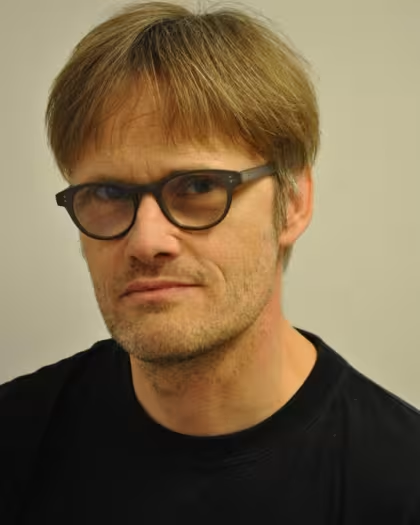
Henrik Glenner
Position
Professor, Marine organismal biology
Affiliation
- henrik.glenner@uib.no
- Phone number
- +47 55584526
- Visitor address
-
Thorm酶hlens gate 53 A/B
5006 Bergen - Postal address
-
P.O. Box 7803NO-5020 BergenNorway
Henrik Glenner
Position
Professor, Marine organismal biology
Affiliation
Research groups
Research
My field of research concerns faunistics, especially with focus on crustaceans and can be divided in 4 major points:
1) Lifecycle studies of barnacles and related crustacean groups have constituted a major part of my research activities. These animals are unique among crustaceans since they all, without exceptions, alternates between a free-living larva stage and an irreversible attached adult and detailed lifecycle studies have proved essential in attempting to understand their morphology, ecology and evolution.
2) Invasive species present an increasing threat to the marine environment in Norway and other places. Knowledge about the mechanisms enabling exotic marine species to invade new areas and the possible ways to prevent them from happening is an important field of marine research. In the recent years I have been studying the population dynamic and genetics of two invasive marine crab species and their most prominent parasite, a parasitic barnacle or rhizocephalan, which as adult castrates their crab hosts. The data from the study of these model systems will be used to evaluate if it is possible to control biological invasions in marine systems by the use of parasites.
3) Solid information about the phylogenetic relationships between living organisms is crucial in order to address relevant and correct biological questions. I am, therefore, interested in how to construct the most reliable phylogeny by the use of data from diverse data like dna, fossils and morphological and geographical sources. My major phylogentic interest concerns the parasitic barnacles, Rhizocephala, but I am also occupied with other phylogenetic issues, especially within crustaceans.
4) With a maximum depth of over 1300m, the Sognefjord is the deepest fjord in the world. Extending inland over 150km, it provides a unique environment for studying dispersal and population connectivity of benthic marine fauna 鈥� research themes that are central to the understanding of biodiversity. The many side fjords to the Sognefjord are not as deep as the main fjord, and resemble, therefore, the majority of western Norwegian fjords.
So what is the dispersion between side fjords, does the deep main fjord provide a barrier and/or does the system involve a number of relatively 鈥渋solated鈥� populations?
In addition, finding out what is actually living down there is an interesting exercise, since the benthic fauna of the Sognefjord is relatively unexplored and unknown.
These questions are addressed at frequent research cruises by employing classical sampling methodologies (bottom trawls, sledges and dredges), video based habitat and community mapping as well as molecular technologies.
As it appears from the research points above, the type of science I am conducting depends on methods and expertise from many areas of biological research. So despite that I, as a starting point, address questions originating in the classical morphology of marine organisms, the answers I look for rely totally on a multidisciplinary approach.
Teaching
MAR211 / Marin floristikk og faunistikk
MAR212 / Marin samfunns酶kologi - Organismar og habitater
MAR310 / Marine metodar
Bio101/ Organismal biology
Publications
Conference lecture
Research report
Academic article
Media interview
Popular science article
Academic book chapter
Working paper
Exhibition production
Doctoral thesis (PhD)
Academic literature review
Master鈥檚 thesis
Conference abstract
Conference poster
Professional article
Book anthology
Non-fiction monograph
PUBLICATION LIST (LAST 5 YEARS 鈥� since 2016):
Peer reviewed journal publications:
- Noever C, Olson A, Glenner H. (2016). Two new cryptic and sympatric species of the king crab parasite Briarosaccus(Cirripedia: Rhizocephala) in the North Pacific. Zoological Journal Of The Linnean Society 176:3鈥�14.
- Ommundsen A, Noever C, Glenner H. (2016). Caught in the act: phenotypic consequences of a recent shift in feeding strategy of the shark barnacle Anelasma squalicola (Lov茅n, 1844). Zoomorphology:1鈥�15.
- L眉tzen J, Itani G, Jespersen 脜, Hong J-S, Rees D, Glenner H. (2016). On a New Species of Parasitic Barnacle (Crustacea: Rhizocephala), Sacculina shiinoi sp. nov., Parasitizing Japanese Mud Shrimps Upogebia spp. (Decapoda: Thalassinidea: Upogebiidae), Including a Description of a Novel Morphological Structure in the Rhizocephala. Zoological Science 33:204鈥�212.
- Nagler C, H枚rnig MK, Haug JT, Noever C, H酶eg JT and Glenner H. (2017). The bigger, the better? Volume measurements of parasites and hosts: Parasitic barnacles (Cirripedia, Rhizocephala) and their decapod hosts. PLOS ONE 12(7): e0179958.
- Nagler C, HaugJT., Glenner H, and Buckeridge J. (2017). Litholepas klausreschi gen. et sp. nov., a new neolepadine barnacle (Cirripedia, Thoracica) on a sponge from the Upper Jurassic lithographic limestones of southern Germany. Neues Jahrbuch fu虉r Geologie und Pal盲ontologie, Abhandlungen, 284 (1), 29-42.
- Waiho K, Fazhan H, Glenner H, Ikhwanuddin M. (2017). Infestation of parasitic rhizocephalan barnacles Sacculina beauforti (Cirripedia, Rhizocephala) in edible mud crab, Scylla olivacea. Esteban M脕, ed. PeerJ. 5:e3419. doi:10.7717/peerj.3419.
- Olesen J, Meland K, Glenner H, Van Hengstum PJ, Iliffe TM. (2017). Xibalbanus cozumelensis, a new species of Remipedia (Crustacea) from Cozumel, Mexico, and a molecular phylogeny of Xibalbanus on the Yucat谩n Peninsula. EJT 0:1鈥�27.
- Noever C, Glenner H. (2018). The origin of king crabs: hermit crab ancestry under the magnifying glass. Zoological Journal Of The Linnean Society. 182, 300鈥�318.
- Mouritsen, KN., L眉tzen, L., Geyti, SNS., H酶eg, JT., Glenner, H. (2018). Population dynamics and development of the rhizocephalan, Sacculina carcini, parasitic on the shore crab, Carcinus maenas. Diseases of Aquatic Organisms. 131: 199-211.
- Rees, DJ., Noever, C., Finucci, B., Schnabel, K., Leslie, R., Drewery, J., Bergum, HOT., Glenner, H. (2019). De-novo innovation allows shark-parasitism and prompts a global expansion of the barnacle Anelasma squalicola. Current Biology. 29:R562鈥�3. doi:10.1016/j.cub.2019.04.053.
- Rytter Jensen, A., Ree, M., Glenner, H., L眉tzen, J., H酶eg, JT. (2019). Variation in juvenile stages and success of male acquisition in Danish and French populations of the parasitic barnacles Sacculina carcini (Cirripedia Rhizocephala) parasitizing the shore crab Carcinus maenas. Marine Biology Research. 15:191鈥�203. doi:10.1080/17451000.2019.1612071.
- Lozano-Fernandez, J., Giacomelli, M., Fleming, J., Chen, A., Vinther, J., Francis Thomsen, P., Glenner H., Palero, F., Legg, DM., Iliffe, TM., Pisani, D., Olesen, J. (2019). Pancrustacean evolution inferred from taxon-rich genomic-scale data sets and using an expanded remipede sampling. Genome Biology and Evolution: 1鈥�25. doi:10.1093/gbe/evz097.
- Dang, BT., Le, Q., Sang, TQ., Glenner, H. (2019). Species Diversity and Phylogenetic Relationships of Symbiotic Crustaceans on Portunus Pelagicus (Linnaeus, 1758) in Vietnam. Proceedings of ISER 169th International Conference, Bangkok, Thailand, 21-22 November, 2018: 31-38.
- Ewers-Saucedo, C., Owen, CL., P茅rez-Losada, M., H酶eg, JT., Glenner, H., Chan, BKK., Crandall, KA. (2019). Towards a Barnacle Tree of life: Integrating diverse phylogenetic efforts into a comprehensive hypothesis of thecostracan evolution. PeerJ 2019;7:e7387鈥�21. doi:10.7717/peerj.7387.
- Dang, BT., Rahman, MA., Tran, SQ, Glenner, H. (2019). Genome-wide SNP analyses reveal population structure of Portunus pelagicus along the Vietnam coastline. PLoS ONE 14(11):e0224473.
- H酶eg, JT., Noever, C., Rees, DA., Crandall, K., Glenner, H. (2020). A new molecular phylogeny-based taxonomy of parasitic barnacles (Crustacea: Cirripedia: Rhizocephala), Zoological Journal of the Linnean Society 190 (2), 632-653.
- Nguyen H-TT, Dang BT, Glenner H, Geffen AJ. (2020). Cophylogenetic analysis of the relationship between anemonefish Amphiprion (Perciformes: Pomacentridae) and their symbiotic host anemones (Anthozoa: Actiniaria). Marine Biology Research 16:117鈥�33. doi:10.1080/17451000.2020.1711952.
- Nunez, JCB., Ferranti DA., Rong, S., Damian-Serrano, A., Neil, KB., Glenner, H., Elyanow, RG., Bianca R. P. Browna, Rosenblad, MA., Blomberg, A., Johannesson, MA. and Rand,, DM. (2020) Ecological load and balancing selection in circumboreal barnacles. bioRxiv; 2020. DOI: 10.1101/2020.07.18.209569.
- Korn, O., Golubinskaya, DD., Rees, JA., Glenner, H., H酶eg, JT. (2020). Phylogenetic Position, Complete Larval Development and Larval Sexual Dimorphism in a Rhizocephalan Barnacle, Lernaeodiscus rybakovi sp. nov. (Cirripedia: Rhizocephala: Peltogastridae), Parasitizing the Crab Pachycheles stevensii Stimpson, 1858 (Decapoda: Anomura: Porcellanidae). Zoologischer Anzeiger 287: 178-197.
- Fazhan H, Waiho K, Glenner H, Moh JHZ, Hassan M and Ikhwanuddin M. (2020). Gonadal Degeneration and Hepatopancreas Alteration in Orange Mud Crab Scylla olivacea Infected with Sacculina beauforti (Crustacea; Rhizocephala; Sacculinidae). Front. Mar. Sci. 7:534443. doi: 10.3389/fmars.2020.534443.
- Chan, B., Dreyer, N., Gale, A., Glenner, H., Ewers-Saucedo, C., Perez-Losada, M., Kolbasov, GA., Crandall, K M., H酶eg, JT., (2021). The Evolutionary Diversity of Barnacles with an Updated Classification of Fossil and Living Forms. Zoological Journal of the Linnean Society. 190 (2), 632-653.
- Waiho K, Glenner H, Miroliubov A, Noever C, Hassan M, Ikhwanuddin M. and Fazhan, H. (2021). Rhizocephalans and their potential impact on crustacean aquaculture. Aquaculture 2021;531:735876. doi:10.1016/j.aquaculture.2020.735876.
- Dang BT, Truong OT, Tran SQ, Glenner H. 2021. Comparative population genetics of swimming crab host (Portunus pelagicus) and common symbiotic barnacle (Octolasmis angulata) in Vietnam. PeerJ 9:e11671 http://doi.org/10.7717/peerj.11671
- Nunez, J. C. B., Rong, S., Damian-Serrano, A., Burley, J. T., Elyanow, R. G., Ferranti, D. A., Neil, K. B., Glenner, H., Rosenblad, M. A., Blomberg, A., et al. (2021). Ecological Load and Balancing Selection in Circumboreal Barnacles. Molecular Biology And Evolution 38, 676鈥�685.
- Nunez, J. C. B., Rong, S., Ferranti, D. A., Damian-Serrano, A., Neil, K. B., Glenner, H., Elyanow, R. G., Brown, B. R. P., Alm Rosenblad, M., Blomberg, A., et al. (2021). From tides to nucleotides: Genomic signatures of adaptation to environmental heterogeneity in barnacles. Mol Ecol. 2021;00:1鈥�17.
- Glenner H, Lu虉tzen J, Pacheco-Ria帽o LC, Noever C (2021) Expansion of the barnacle Austrominius modestus (Darwin, 1854) (Cirripedia, Thoracica, Balanidae) into Scandinavian waters based on collection data and niche distribution modeling. Aquatic Invasions 16(4): 675鈥�689, https://doi.org/10.3391/ai.2021.16.4.06
- Uhlir C, Schwentner M, Meland K, Kongsrud JA, Glenner H, Brandt A, Thiel R, Svavarsson J, L枚rz A, Brix S. 2021. Adding pieces to the puzzle: insights into diversity and distribution patterns of Cumacea (Crustacea: Peracarida) from the deep North Atlantic to the Arctic Ocean. PeerJ 9:e12379
- Korn, O. M., Golubinskaya, D. D., Rees, D. J., Glenner, H. & H酶eg, J. T. (2021)The second rhizocephalan species, Lernaeodiscus kasyanovi sp. nov. (Cirripedia: Rhizocephala: Peltogastridae), parasitizing the porcellanid crab Pachycheles stevensii Stimpson, 1858 (Decapoda: Anomura: Porcellanidae), from Russian waters of the Sea of Japan. Mar. Biodivers. 51, 5. 1-9.
- Al-Wazzan, Z., Waser, A.M., Glenner, H. Gimenez, L., and Thieltges. DW. (2021). Temporal and spatial infection patterns of the rhizocephalan parasite Parasacculina leptodiae (Gu茅rin-Ganivet, 1911) in the crab Leptodius exaratus along the shores of Kuwait. Mar. Biodivers. 51, 90 (2021). https://doi.org/10.1007/s12526-021-01235-3
Peer reviewed book chapters:
- H酶eg JT, Rees DJ, Jensen PC, Glenner H. (2019). Unravelling the Evolutions of the Rhizocephala: A Case Study for Molecular-Based Phylogeny in the Parasitic Crustacea. Parasitic Crustacea, vol. 3. 3rd ed., Cham: Springer, Cham; 2019, pp. 387鈥�419. doi:10.1007/978-3-030-17385-2_9.
- Buhl-Mortensen, L., Buhl-Mortensen, P., Glenner, H., B氓mstedt, U., Bakkeplass, K. (2020). The inland deep-sea Benthic biotopes in the Sognefjord. In: Seafloor Geomorphology as Benthic Habitat. 2nd ed., Elsevier Science, pp. 337 鈥� 357. Editors: Peter Harris and Elaine Baker. ISBN: 9780128149607.
- Glenner, H., H酶eg, J.T., Rees, D.J, Schubart, C.D. (2021). Phylogenetic Analyses Suggest a Single Origin of Freshwater Barnacles. In: Kawai, T., & Rogers, D.C. (Eds.). Recent Advances in Freshwater Crustacean Biodiversity and Conservation (1st ed.). CRC Press. P. 3-18. .
Books:
- Salvanes AGV, Devine J, Jensen KH, Hestetun JT, Sj酶tun K Glenner H. (2018). Mar. Ecol. Field Methods. A Guide for Marine Biologists and Fisheries Scientists. Wiley Blackwell. ISBN: 978-1-119-18434-8. 320 pages.
Technical rapports:
- Hob忙k A, Birkeland I.B, Haug L.M.H, Glenner H. (2017). Genetic connectivity among fiord basins in benthic invertebrates. Norwegian Institute for Water Research, ISBN 978-82-577-6864-5.
- Rees, DJ and Glenner, H. (2017). Final rapport for The Norwegian Biodiversity Information Centre project: 鈥� Biodiversity and nature types in the Sognefjord鈥�. P 1 鈥� 15.
- Noever, C and Glenner, H. (2017). Investigation and mapping of the Norwegian barnacle fauna (Crustacea: Cirripedia). Final rapport for The Norwegian Biodiversity Information Centre
Publications in popular form:
- Petersen JK, Glenner H, Nielsen P, and L眉tzen J. (2017). Invasive arter i Limfjorden. Kaskelot 215: 36-40. ISSN 0106-0023.
- Buhl-Mortensen L, Buhl-Mortensen P, Glenner H and B氓mstedt U. (2017). Dyphavshabitater langt inn i landet: Nye under颅s酶kelser av havbun颅nen i Sognefjorden NATUREN (6): 246-251. DOI: 10.18261/issn.1504-3118-2017-06-03.
- Glenner H. (2018). P氓 vej mod parasitisme: om hajruren, Anelasma squalicola. Kaskelot 2019: 30-34. ISSN 0106-0023.
Projects
"The Green crab in the danish inlet: Limfjorden", A large scale, home range study on a prominent marine invasive species and its native enemies鈥�, financed by the Carlsberg Foundation
Homepage:
鈥淏iodiversity of parasitic crustaceans in Norwegian fjords鈥�, financed by the Carlsberg Foundation. Norwegian Biodiversity Information Centre