

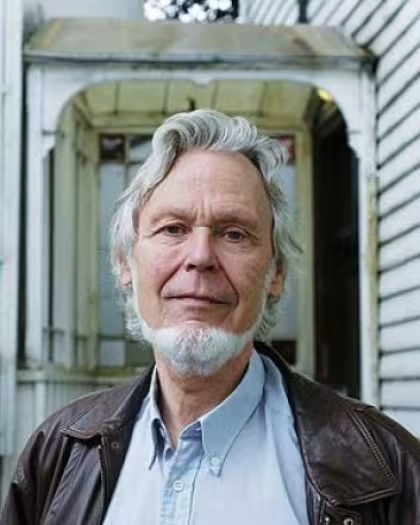
Gunnar Skirbekk
Position
Emeritus, Professor
Affiliation
- gunnar.skirbekk@uib.no
- Phone number
- +47 55582845
- Visitor address
-
Parkveien 9
5007 Bergen - Postal address
-
P.O. Box 7805NO-5020 BergenNorway
Gunnar Skirbekk
Position
Emeritus, Professor
Affiliation
Research
On the basis of extensive discussions, i.a. in the philosophy environment at the University of Bergen in the 1960s and 1970s, Gunnar Skirbekk has worked with colleagues at home and abroad to develop a philosophical way of thinking that combines context-pragmatic forms of thought as in the late Wittgenstein, which works with example-based presupposition-analyses, e.g. with so-called "absurdity arguments", and transcendental-pragmatic forms of thought as in Apel and the early Habermas, where one works reflectively with universal preconditions for basic speech-acts, e.g. in scientific research and serious discussions. Cp. the anthology Die pragmatische Wende: Sprachspielpragmatik oder Transzendentalpragmatik?, eds. Dietrich B枚hler, Tore Nordenstam and Gunnar Skirbekk, Suhrkamp 1986. The way of thinking that Skirbekk defends is often referred to as "transcendental praxeology" or "the praxeology of modernity" (German book title, Praxeologie der Moderne). The point, briefly stated, is a defense of different varieties of situated and binding validity, with a sting both against (postmodernist) relativism and (scientistic) dogmatism. See e.g. his article "Contextual and Universal Pragmatics: Mutual Criticism of Praxeological and Transcendental Pragmatics", in Philosophy beyond Borders. An Anthology of Norwegian Philosophy, eds. Ragnar Fjelland et al., 1997, in Chinese 1999 and revised edition 2016.
Themes and projects
Existentialism: the problem of evil and a search for universally valid principles, in a post-WWII-setting. Nihilisme? Eit ungt menneskes fors酶k p氓 氓 orientere seg, 1958; Nihilism? A Young Man鈥檚 Search for Meaning, 1972. Literary essays in Ord, 1984, and Undringa, 2002.
Praxeology: case-oriented studies of what is necessarily (and most often 鈥榯acitly鈥�) presupposed in basic human acts of different kinds; early Heidegger versus late Wittgenstein. Praxeology. An Anthology, ed./co-auth., 1983.
Theory of Truth: first, Heidegger鈥檚 theory of truth, in a critical analytic perspective, Dei filosofiske vilk氓r for sanning, 1966, Truth and Preconditions. An Interpretation of Heidegger鈥檚 Theory of Truth, 1970; later, by the pragmatic turn, focusing on arguments in public reasoning and self-reflection, both as to universality and contextuality (in between Apel, Habermas, and late Wittgenstein), e.g. Rationality and Modernity. Essays in Philosophical Pragmatics, 1993; Wahrheitstheorien, ed./co-auth., 1977; 鈥淲ahrheit und Begr眉ndung. 脺berlegungen zu epistemischen Begriffen und Praktiken鈥� in Reflexion und Verantwortung, co-ed./co-auth., 2003.
Transcendental Pragmatics, conceived melioristically, focusing on improvement, in critical self-reflection, public reasoning, and 鈥榯hinking through examples鈥�, e.g. by 鈥榓rguments from absurdity鈥�. Mutual learning-processes and mutual recognition as fallible and reasonable human beings, by discursive will-formation. E.g. Rationality and Modernity. Essays in Philosophical Pragmatics, 1993; Timely Thoughts. Modern Challenges and Philosophical Responses: Contributions to Inter-Cultural Dialogues, 2007; 鈥淥n the Advantage and Disadvantage of Transcendental Pragmatics for Life. A historical perspective on the late Frankfurt School (Apel, Habermas, Wellmer)鈥�, 2016.
Political theory: neo-marxism, alienation, critique of ideology, Nymarxisme og kritisk dialektikk, 1970; Er ideologiane d酶de? ed./co-auth., 1970. The notion of a Welfare State under difficult conditions, 鈥淭he Idea of a Welfare State in a Future Scenario of Great Scarcity鈥�, in The Rationality of the Welfare State, 1996: 28-54; updated version, Ideen om ein velferdsstat under vanskelege vilk氓r, 2015. The notion of citizenship in modern democracies haunted by multiple and complex crises. Personal autonomy (M眉ndigkeit) as a regulative idea. E.g. Krise og medansvar (Crisis and co-responsibility), 2016.
Eco-philosophy: Marxism and ecology, 鈥淢arxisme et 茅cologie鈥�, Esprit 11/1974, English version in The Greening of Marxism, 1996: 129-136. Science and ecology, 鈥淭echnological expertise and global ethics in an age of scientization and ecological crisis鈥�, Timely Thoughts, 2007. Capitalism and ecology, The Commercial Ark, co-ed./co-auth., 1992, The Notion of Sustainability, ed./co-auth., 1994, 脴konomi, 酶kologi, etikk, 1999. Ethical gradualism, in Deutsche Zeitschrift f眉r Philosophie 31/1995; revised English version, 鈥淓thical Gradualism, beyond Anthropocentrism and Biocentrism?鈥� in Environment, Embodiment, and Gender, 2005: 149-177.
Philosophy of the sciences and the humanities: Objektivitetsproblemet i vitskapane, ed./co-auth., 1984. Vit og vitskap, 1998. Vitskapsteori 鈥� positive eller kritisk? 2004. 鈥淎 crisis in the humanities?鈥�, Timely Thoughts, 2007. At Senter for vitskapsteori (Center for the studies of the sciences and the humanities), when it was established at the University of Bergen in 1987, there was a research project (financed by the Norwegian Research Council) called 鈥淢odernitet 鈥� differensiering og rasjonalisering鈥� (Modernity 鈥� differentiation and rationalization, in a Weberian sense). See next theme:
Theory of Modernization, conceived in terms of development of different scientific/scholarly and practice-based forms of rationality and 鈥榯acit knowing鈥� (not merely instrumental rationality, but also interpretive and argumentative rationality), historically situated in decisive actors, institutions, and collective experiences. A focus on general modernization processes, but also on special ones 鈥� e.g. in Scandinavia: Multiple Modernities. A Tale of Scandinavian Experiences, 2011 (Norwegian version Norsk og moderne, 2010). These countries are characterized by general trust, rule of law, and a general and generous welfare state 鈥� how come? (Cf Francis Fukuyama鈥檚 ideal: 鈥済etting to Denmark!鈥�) Also, in a modern world: general pathologies and challenges; imbalance between institutions; imbalance between institutions and their cultural preconditions; globalized, technology-based capitalism, with ecological challenges, and mass migration. Also in Krise og medansvar, 2016.
History of Western Thought: A history of philosophy from ancient Greece to the twentieth century, with special emphasis on the history of the sciences and the humanities and on political thinking. English version, A History of Western Thought, 2000, together with Nils Gilje. Available in 17 languages. Norwegian original, Filosofihistorie, first version 1970, 8th edition 2007.
Freedom of expression: its justification and challenges, Vit og vitskap, 1998: 88-128. Member of the Norwegian commission for the revision of 搂 100 (on freedom of expression) in the Norwegian Constitution (1993-1996). Freedom of expression as a precondition for science and democracy, not merely a 鈥渨estern value鈥�. E.g. 鈥淥n the normative foundation of the freedom of expression: the same freedom for all expressions?鈥� in I f酶rste, andre og tredje person. Festskrift for Audun 脴fsti, 1999: 319-326. 鈥淵tringsfridom i ei globalisert verd. Med striden om Muhammed-teikningane friskt i minne: korleis kan vi grunngje rettsprinsippet om ytringsfridom i eit globalisert verdssamfunn? 鈥� 脜rbok for Det norske videnskaps-akademi 2007:266-282.
Critique of Religion: the problem of evil in monotheism (Judaism, Christianity, Islam) and its theological and practical implications (cf Nihilism? 1958). The inherent need for an open and enlightened critique of religion. The need to avoid unintended blasphemy among strong believers without cultural enlightenment. E.g. Herausforderungen der Moderne aus wissenschaftsphilosophischer Sicht, 2012. Challenges caused by a politicization of religion, without the moderating virtues of cultural enlightenment (be it in the Middle East or the Mid-West); especially in cases of 鈥渉alf-modernization鈥� in terms of modern weaponry and means of communication and premodern mentalities and actions (as in ISIL and Boko Haram). Krise og medansvar, 2016: 67-120.
Crisis in the modern world: The modern world is in crisis, a double crisis, as it were: at the factual level, with various challenges that tend to interact and reinforce each other, and at the epistemic level, where no single science or expertise alone can grasp the complexity of what is going on. In this publication, such basic epistemic challenges are addressed, critically and constructively; and in this perspective four current cases are discussed and assessed, such as the United Nations Agenda 2030 for sustainable development. On this background, some proposals for epistemic and institutional improvements are considered. Cp. Gunnar Skirbekk, Epistemic Challenges in a Modern World. From 鈥渇ake news鈥� and 鈥減ost truth鈥� to underlying epistemic challenges in science-based risk-societies. LIT Verlag, Zeitdiagnose, Z眉rich 2019.
Outreach
Interviews, talks, presentations and mentions
Panelist in meeting at the University Museum, 24.11.2022
Lecture at Bergen offentlege bibliotek, 23.11.2022
(in Norwegian), Khrono. 13.11.2022
. Interview in Bergensmagasinet (in Norwegian), 05.06.2022
. Meeting at , 黑料吃瓜资源, 09.03.2022
Academic lunch at Bergen public library, 26.01.2022
Moderne vitskapsbaserte samfunn og skriftbaserte monoteistiske religionar. Lecture at the annual meeting of the Bergen local chapter of , 12.02.2022
Dag og Tid (weekly newspaper for culture and politics), 12.11.21 (in Norwegian, behind paywall)
Norwegian Christian daily Dagen, 10.11.21 (in Norwegian, behind paywall)
. Interview, Dagens perspektiv, 28.10.21 (in Norwegian)
. Skirbekk held two lectures related to Kazakhstan's 30th anniversary of independence. Organizers were and the public association with the support of the Embassy of Kazakhstan in Norway.
The Idea of a Global History of Philosophy. Presentation during the international online conference , 30-31.01.2021
Writings
. Opinion piece in Norwegian daily Klassekampen, 26.05.23 (in Norwegian, behind paywall)
Opinion piece in Norwegian weekly Dag og Tid, 14.07.23 (in Norwegian, behind paywall)
Response to , Prosa 1/2022
. Opinion piece in Dag og Tid, 09.09.22 (in Norwegian, behind paywall)
Opinion piece in Klassekampen, 22.03.22 (in Norwegian, behind paywall)
. Opinion piece in Norwegian daily Bergens Tidende, 09.09.21 (in Norwegian)
Opinion piece in Klassekampen, 23.03.21 (in Norwegian, behind paywall)
Comment in Klassekampen, 12.03.21 (in Norwegian, behind paywall)
. Opinion piece in Klassekampen, 17.02.2021 (in Norwegian, behind paywall)
. Opinion piece in Uniforum, 04.09.2020 (in Norwegian)
Podcasts
- recording of , 黑料吃瓜资源, 09.03.2022 (in Norwegian)
- recording of Academic lunch at Bergen public library, 26.01.2022 (in Norwegian)
Podcast by Bergen Global, 2020 (in Norwegian).
. Podcast episode, November, 2020 (in Norwegian)
Teaching
History of Western Thought. Enlightenment and Modernization (A History of Western Thought, English version 2001, together with Nils Gilje; by 2015 in 18 languages).
Publications
Selected publications
Multiple Modernities, Hong Kong 2011
Herausforderungen der Moderne aus wissenschaftsphilosophiscer Sicht, Berlin 2012
Krise og medansvar, Oslo 2016
Overview of output in Cristin:
Projects
Multiple modernities: how to conceptualize processes of modernization.
Crises in modern societies.