

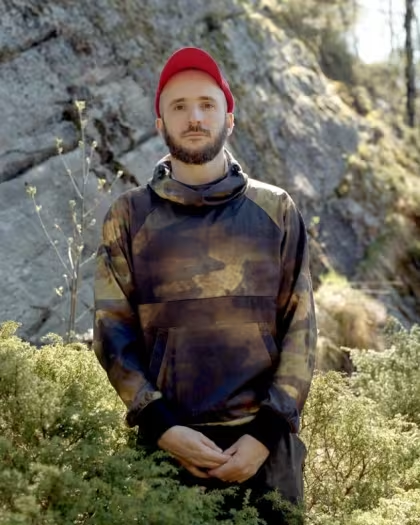
Gabriele de Seta
Position
Researcher, Project leader (algofolk)
Affiliation
- gabriele.seta@uib.no
- Visitor address
-
Langes Gate 1-3
5007 Bergen - Postal address
-
P.O. Box 7805NO-5020 BergenNorway
Gabriele de Seta
Position
Researcher, Project leader (algofolk)
Affiliation
Short info
Research
Gabriele de Seta is, technically, a sociologist. He is a Researcher at the University of Bergen, where he leads the ALGOFOLK project (“Algorithmic folklore: The mutual shaping of vernacular creativity and automation”) funded by a Trond Mohn Foundation Starting Grant (2024-2028). Gabriele holds a PhD from the Hong Kong Polytechnic University and was a Postdoctoral Researcher at the Institute of Ethnology, Academia Sinica and at the University of Bergen, where he was part of the ERC-funded project “”. His research work, grounded on qualitative and ethnographic methods, focuses on digital media practices, sociotechnical infrastructures and vernacular creativity in the Chinese-speaking world. He is also interested in experimental, creative and collaborative approaches to knowledge-production.
Outreach
I regularly share research updates on the and , I host interviewing researchers and artists, and I'm happy to talk about my research on any platform - just get in touch!
Teaching
I have designed the "Machine Vision" module for the Digital Culture BA course Critical Approaches to Technology and Society (Fall 2020), and taught the MA course Key Theories in Digital Culture (fall 2021). I regularly give guest lectures and lead workshops at international institutions. I am currently supervising PhD candidates Hanna Lauvli and Yagmur Vik.
Publications
My publications are also listed on , and most of them are accessible through links on .
Since my PhD degree, I have done research about : my main interest in this topic is , which includes digital media practices of , , , , , and . I have focused on and other , analyzing how they relate to broader ideas about and to urgent issues like . I have also written about , including and , arguing that they are a form of creativity which is . This has led me to explore and to engage with the concept of , which I have tracked over .
On the technical side of things, I have argued that as they change ; my interest in ranges from the global to minute infrastructural gateways like . With some colleagues, I explored the implications of these changes for , identifying as a new infrastructure of popularity. With others, I speculated that computational infrastructures can be conceptualized as , in which becomes a key dimension. Following the global hype around artificial intelligence, I have charted the development of the , with a particular focus on , its , and , while also examining how it leads to new genres of content like or , which require and .
On the more speculative side, I have argued that tropes about reproduce , and ignore the diversity and richness of . Since my MA degree, I have also occasionally written about underground music, including , , , the complex dynamics of , the and . While researching all of this, I also enjoy thinking about methods, particularly ethnographic ones: I have thought about , and ; I reflected on the ; and I have articulated some strategies to , expanding this toolbox to include the and the functioning of .
More recently, I have developed the concept of , which brings together three key threads woven throughout my research career: automated systems, computational infrastructures, and vernacular creativity.